My favorite quote has never been one from a famous author.
It came from my father:
“Sometimes you have to care enough to know not to care too much.”
I’ve found myself repeating it throughout my life.
As I’ve gotten older, I’ve realized it wasn’t about caring less. It was about caring deeply—without letting the outcome consume you. Whether it’s sports, music, work, or life itself, the moment you become too attached to winning, proving yourself, or getting it perfect, you often lose the very thing that got you there.
There is a particular architecture to this part of town.
The fire escapes aren’t there to save anyone.
They’re there to hold up the shadows.
On every corner, the devil dogs are waiting.
Demonic little bastards with gold teeth and neon eyes, selling pieces of salvation wrapped in tin foil, lining the curbs like gargoyles in cheap leather jackets.
You’d think darkness would swallow everything whole.
You’d think the weight of it would collapse the lungs of anything still trying to breathe.
Then you see her.
She didn’t descend from some celestial cloud.
There were no trumpets.
No holy light clearing the way.
She arrived.
Busted up, but not broken.
Looking like she’d been dragged through three different levels of someone else’s nightmare and somehow walked back out.
Her wings aren’t pristine white. They’re jagged poetry stitched together with scar tissue, feathers matted with street oil, soot, and sweat.
She looks like hell.
Her spirit doesn’t.
Deep in the alley, where a dead tree forces itself through cracked brick like a broken rib, she finds a place to perch.
The devil dogs gather below.
They hiss.
Throw stones.
Flash their knives beneath the neon.
She doesn’t move.
She watches them the way mountains watch weather.
Unfettered.
A creature no gatekeeper would recognize, carrying something no devil can counterfeit.
You can break the bone.
You can clip the edges.
You can grind every bright color into a bruised gray.
How do you know when it’s time to unplug? What do you do to make it happen?
Unplugged From What?
People talk about unplugging like it’s a universal concept.
It isn’t.
If you ask ten people what they’re plugged into, nine will point at the glowing rectangle in their hand.
Fair enough.
The phone has become humanity’s sixth finger. We carry it everywhere. We sleep beside it. Some people panic if they can’t find it for thirty seconds, as though they’ve misplaced a kidney.
But the phone is rarely the thing.
The phone is just the delivery system.
The real question is:
What owns your attention when nobody is forcing it to?
That’s what you’re plugged into.
For some people it’s social media.
For others it’s work.
For others it’s outrage, anxiety, validation, nostalgia, revenge, regret, or the endless fantasy that happiness is waiting just beyond the next achievement.
The device changes.
The attachment doesn’t.
I know it’s time to unplug when I catch myself reaching for something without deciding to.
When my hand moves before my brain.
When I’m scrolling and couldn’t tell you what I’ve seen for the last ten minutes.
When I’m checking email that doesn’t matter.
When I’m consuming instead of creating.
When I’m reacting instead of observing.
Those are usually the warning lights on the dashboard.
And what do I do to make it happen?
Nothing heroic.
I write.
I walk.
I sit with a cup of coffee before the rest of the world wakes up.
I pet Martha.
I stare out a window longer than modern society considers acceptable.
Sometimes I play guitar.
Sometimes I just let the silence make me uncomfortable until it stops being uncomfortable.
Because unplugging isn’t really about escaping technology.
It’s about reclaiming attention.
The phone gets blamed because it’s easy to point at.
But you can be completely unplugged with a smartphone in your pocket and completely plugged in while sitting alone in a cabin in the woods.
One is a device.
The other is a condition.
Most people are trying to unplug from the device.
I’m trying to unplug from the condition.
The device is easy.
The condition takes practice.
And if we’re being honest, I’m not sure the goal is ever to completely unplug.
I think the goal is simply to remember who’s holding the cord.
There was a time when asking someone for two uninterrupted minutes of attention was a modest request. Today, it borders on hostage-taking.
The evidence is not merely anecdotal. Human attention has not wandered off for a cigarette and promised to return. It has collapsed in broad daylight while we all watched.
The average person now grants a piece of content roughly 8 seconds before rendering judgment. Teenagers switch between applications every 44 seconds. Less than half of viewers survive the first minute of a video, regardless of its length. Only a small fraction remain standing by the final ten seconds. The first thirty seconds are not an introduction anymore; they are a battlefield littered with casualties.
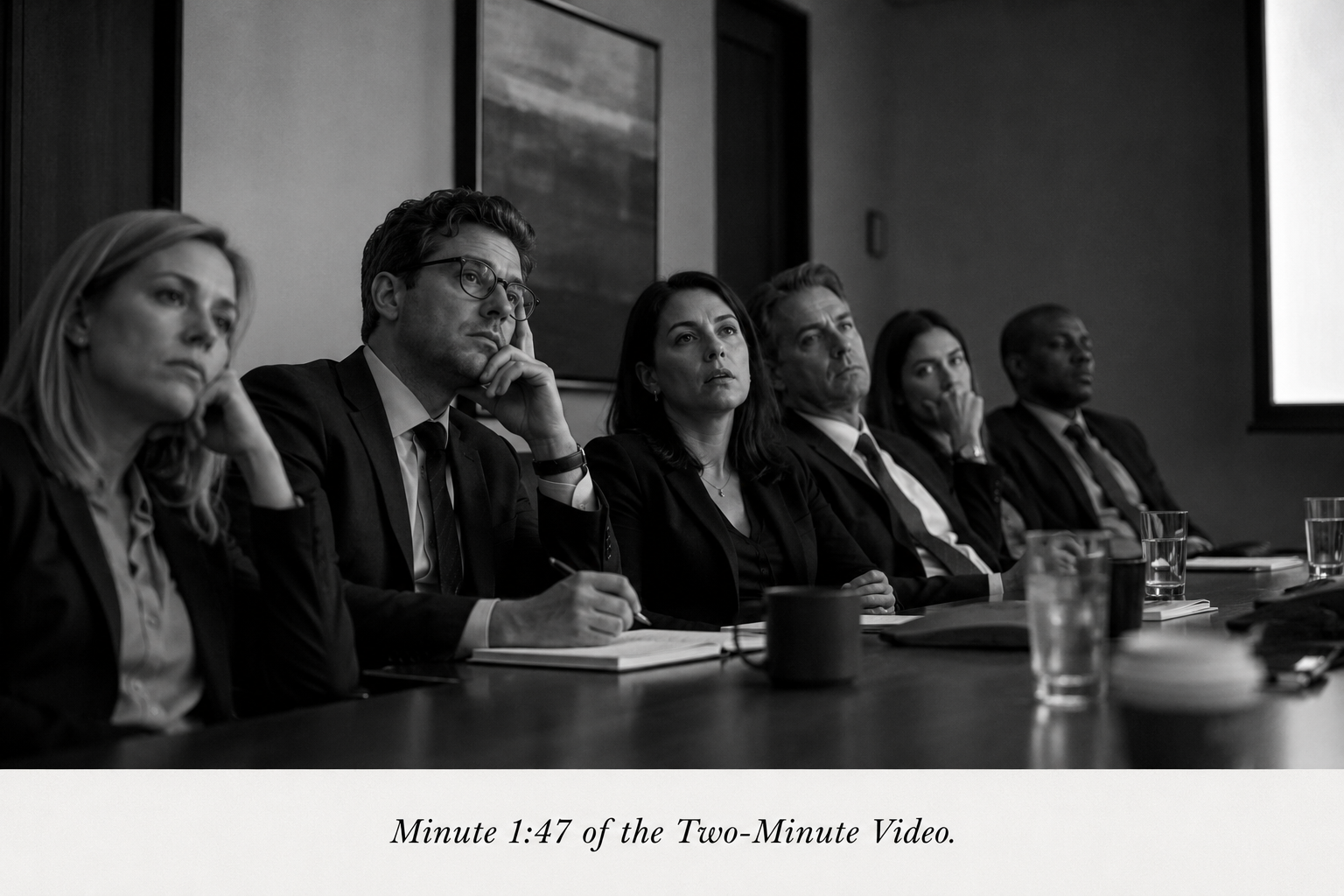
Yet every week, somewhere in a conference room with poor coffee and an abundance of PowerPoint slides, someone proposes a two-minute B2B video.
This is usually justified by invoking seriousness.
“It’s business-to-business.”
“It needs more detail.”
“We have a lot to say.”
No, it doesn’t.
What it has is a lot of things that nobody was willing to cut.
The notion that professionals suddenly transform into patient scholars when seated at a laptop on a Tuesday afternoon is one of the more charming delusions of modern marketing. The procurement manager watching your video is the same human being who spent the weekend scrolling through TikTok at six-second intervals. The brain does not enter a special “corporate patience mode” simply because the viewer’s badge works at an enterprise software company.
The numbers are merciless. Viewers decide within seconds whether something deserves their attention. Slow openings lose a majority of the audience almost immediately. Average retention rates across video platforms are, frankly, horrific. Long-form consumption continues its slow decline while multitasking rises and content exposure explodes.
In other words, the audience has spoken. Repeatedly. Loudly.
What remains fascinating is the industry’s refusal to listen.
There is, of course, one notable exception. People will watch long-form content from creators they trust. Devoted audiences routinely spend hours with their favorite podcasters, commentators, and personalities.
The operative word is earned.
A beloved creator can ask for two hours because they have spent years earning that privilege. A corporate brand unveiling its latest fleet management solution has not.
Confusing the two is like mistaking a first date for a golden anniversary.
The deeper issue, however, is not effectiveness. It is respect.
Every unnecessary second in a video represents a small act of arrogance. It assumes the audience’s time is less valuable than the creator’s desire to explain. It suggests a lack of confidence in the message itself. The longer the video becomes, the more it begins to feel like a negotiation with uncertainty.
Brevity is not the enemy of intelligence.
Brevity is evidence of it.
A concise video communicates something powerful: we know what matters, we know what doesn’t, and we trust you to understand the difference.
Nobody remembers the two-minute explainer.
They remember the thirty-second piece that made them feel something, understand something, or see something differently.
The purpose of communication is not to exhaust a subject. It is to illuminate it.
Everything after that is often just vanity wearing a lanyard.
They ask about the weather like it’s a holy event. like rain personally offended them. like the clouds filed paperwork.
Forecasts for the spiritually dead
“Cold enough for ya?” No. Shoot me.
If I ever become a man who sincerely discusses wind chill at a dinner party, I authorize immediate execution. Nearest firearm. Center mass. No hesitation.
Because weather talk is the last known stage before the soul calcifies.
You can watch it happen in real time.
A guy buys orthopedic shoes. Starts saying “we needed this rain.” Uses the phrase “bundle up.” Suddenly he’s standing in a grocery store comparing forecasts like a frightened farmer protecting invisible crops.
Meanwhile the planet spins through infinite black violence, people lose children, go bankrupt, cheat, relapse, pray, fall apart in parked cars at 2AM—
and Gerald from accounting wants to tell me it might snow Thursday.
Beautiful.
That’s the trick, isn’t it?
Human beings inventing tiny safe noises to keep from screaming into the void.
So yes— I nod politely. I participate. I mention precipitation percentages like a good little citizen.
But between us?
I hate cold weather.
Not philosophically. Not poetically. I mean physically hate it.
I hate the gray slush, the dead trees, the windshield scraping, the way winter turns every parking lot into a Soviet painting.
Cold weather feels like punishment for surviving November.
Still— people smile through blue lips and call it “refreshing.”
That’s humanity for you.
Freezing to death politely while discussing the forecast.
Not the boots. Not the jacket. Not the watch pretending time means anything.
It’s the uneasy stomach. The golf ball lodged in the throat. The cracked heart stitched together with bad sleep, caffeine and whatever people call “moving on.”
Those are old. Ancient, really.
Hand-tailored over years by loss, disappointment, memory, guilt, love and the quiet observations you never talk about out loud because everyone else is busy performing wellness like it’s an Olympic sport.
I wear old conversations that never ended properly. Old funerals. Old versions of myself I buried but still hear scratching around under the floorboards at 2 a.m.
None of it was designed by me.
It was made for me.
By every slammed door. Every hospital hallway. Every “I’m fine” that wasn’t. Every moment you realized the world keeps spinning with horrifying confidence no matter what it takes from you.
What’s a job you would like to do for just one day?
I’d like to be a sanitation worker for one day.
Not because I romanticize hard labor. Not because I’m looking for some blue-collar cosplay to post online with a thoughtful black-and-white filter and a caption about “real America.”
No.
I want the job where the city hands you its emptiness before sunrise.
Because I suspect I could learn more about humanity in one shift hanging off the back of a garbage truck than most therapists learn in a lifetime of softly lit offices and polite nodding.
The leftovers. The excess. The secrets people bag up and leave on the curb hoping nobody notices.
It’s one of the few jobs where you physically witness consumption, routine, decay, wealth, loneliness—all street by street. One block smells like expensive candles and Amazon boxes. The next smells like beer cans, cigarettes, and the slow collapse of a marriage. Somewhere in between is a kid’s broken bicycle, still half wrapped in birthday paper.
Civilization revealed through what it throws away.
No performance. No meetings. No decks. No branding language. No buzzwords and bullshit disguised as productivity.
Just brutal usefulness.
The world falls apart in about seventy-two hours without sanitation workers. Three days. That’s all it takes before people start realizing how thin the membrane is between society and rats chewing through the walls. Yet most people treat sanitation workers like background noise right up until the moment they disappear.
I respect that kind of invisible importance.
And there’s something beautiful about the simplicity of it. You wake up. You do the job. By the end of the shift, the streets are cleaner than you found them. Immediate purpose. Visible results. No quarterly alignment meeting required.
Plus, I think I’d enjoy waving at people while riding on the back of the truck, holding on with one arm like the city’s least celebrated cowboy, dirty secrets piled up behind me while the sun slowly crawls over the rooftops.
There’s poetry in that.
Not the kind written in universities or spoken through podcasts sponsored by mattress companies. Real poetry. The kind that smells faintly like diesel fuel, wet cardboard, stale beer, and human denial.
The kind of poetry that reminds you every single person leaves something behind.