My favorite quote has never been one from a famous author.
It came from my father:
“Sometimes you have to care enough to know not to care too much.”
I’ve found myself repeating it throughout my life.
As I’ve gotten older, I’ve realized it wasn’t about caring less. It was about caring deeply—without letting the outcome consume you. Whether it’s sports, music, work, or life itself, the moment you become too attached to winning, proving yourself, or getting it perfect, you often lose the very thing that got you there.
There was a time when asking someone for two uninterrupted minutes of attention was a modest request. Today, it borders on hostage-taking.
The evidence is not merely anecdotal. Human attention has not wandered off for a cigarette and promised to return. It has collapsed in broad daylight while we all watched.
The average person now grants a piece of content roughly 8 seconds before rendering judgment. Teenagers switch between applications every 44 seconds. Less than half of viewers survive the first minute of a video, regardless of its length. Only a small fraction remain standing by the final ten seconds. The first thirty seconds are not an introduction anymore; they are a battlefield littered with casualties.
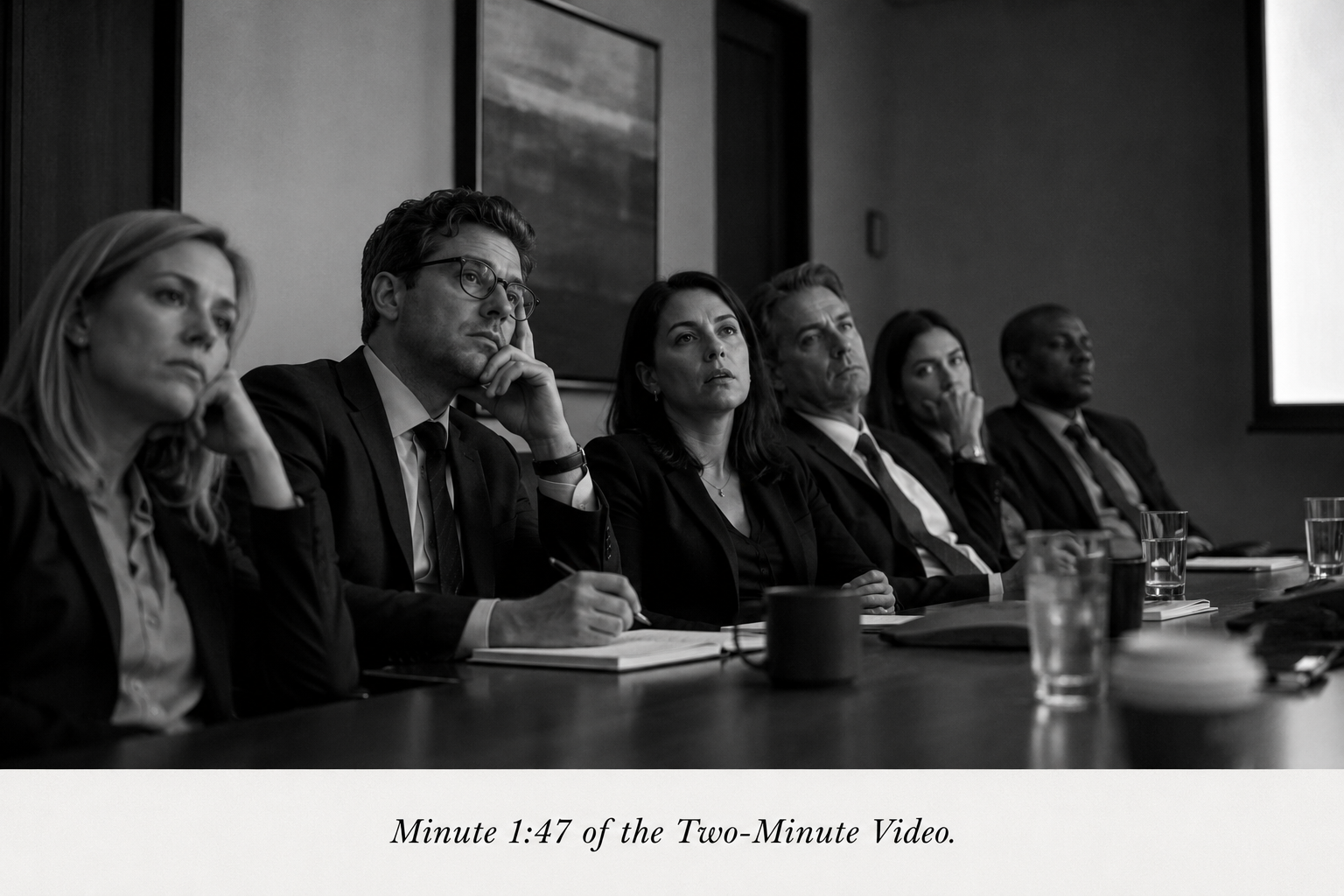
Yet every week, somewhere in a conference room with poor coffee and an abundance of PowerPoint slides, someone proposes a two-minute B2B video.
This is usually justified by invoking seriousness.
“It’s business-to-business.”
“It needs more detail.”
“We have a lot to say.”
No, it doesn’t.
What it has is a lot of things that nobody was willing to cut.
The notion that professionals suddenly transform into patient scholars when seated at a laptop on a Tuesday afternoon is one of the more charming delusions of modern marketing. The procurement manager watching your video is the same human being who spent the weekend scrolling through TikTok at six-second intervals. The brain does not enter a special “corporate patience mode” simply because the viewer’s badge works at an enterprise software company.
The numbers are merciless. Viewers decide within seconds whether something deserves their attention. Slow openings lose a majority of the audience almost immediately. Average retention rates across video platforms are, frankly, horrific. Long-form consumption continues its slow decline while multitasking rises and content exposure explodes.
In other words, the audience has spoken. Repeatedly. Loudly.
What remains fascinating is the industry’s refusal to listen.
There is, of course, one notable exception. People will watch long-form content from creators they trust. Devoted audiences routinely spend hours with their favorite podcasters, commentators, and personalities.
The operative word is earned.
A beloved creator can ask for two hours because they have spent years earning that privilege. A corporate brand unveiling its latest fleet management solution has not.
Confusing the two is like mistaking a first date for a golden anniversary.
The deeper issue, however, is not effectiveness. It is respect.
Every unnecessary second in a video represents a small act of arrogance. It assumes the audience’s time is less valuable than the creator’s desire to explain. It suggests a lack of confidence in the message itself. The longer the video becomes, the more it begins to feel like a negotiation with uncertainty.
Brevity is not the enemy of intelligence.
Brevity is evidence of it.
A concise video communicates something powerful: we know what matters, we know what doesn’t, and we trust you to understand the difference.
Nobody remembers the two-minute explainer.
They remember the thirty-second piece that made them feel something, understand something, or see something differently.
The purpose of communication is not to exhaust a subject. It is to illuminate it.
Everything after that is often just vanity wearing a lanyard.
Not the boots. Not the jacket. Not the watch pretending time means anything.
It’s the uneasy stomach. The golf ball lodged in the throat. The cracked heart stitched together with bad sleep, caffeine and whatever people call “moving on.”
Those are old. Ancient, really.
Hand-tailored over years by loss, disappointment, memory, guilt, love and the quiet observations you never talk about out loud because everyone else is busy performing wellness like it’s an Olympic sport.
I wear old conversations that never ended properly. Old funerals. Old versions of myself I buried but still hear scratching around under the floorboards at 2 a.m.
None of it was designed by me.
It was made for me.
By every slammed door. Every hospital hallway. Every “I’m fine” that wasn’t. Every moment you realized the world keeps spinning with horrifying confidence no matter what it takes from you.
If you could be someone else for a day, who would you be, and why?
If I could be someone else for a day?
First of all, what a suspicious question.
It presumes I am insufficient. It suggests there is a better vantage point. A shinier skull to occupy. A more impressive mask to borrow.
It feels like a parlor game designed for polite envy.
“Lincoln.” “Bowie.” “Einstein.” “Someone rich.”
But after doing a little shadow work — the kind that makes you sit still longer than you want to — I’ve realized something uncomfortable.
The only people I’ve ever wanted to be… were fragments I recognized in myself.
I don’t want to be Abraham Lincoln. I want his steadiness under pressure.
I don’t want to be David Bowie. I want his permission to shapeshift.
I don’t want to be Albert Einstein. I want his refusal to accept the obvious answer.
And as for Fyodor Mikhailovich Dostoevsky — I don’t want to be him either.
I want the sentence I stole from him and pinned above my internal doorway:
“Above all, don’t lie to yourself.”
That’s not identity theft. That’s apprenticeship.
After staring at my own shadow long enough — thank you, Carl Jung — I’ve realized something far less romantic than body-swapping.
The fantasy of being someone else is usually just a refusal to finish being yourself.
There is no other man I would rather inhabit for a day.
Not because I’ve perfected this one. Not because it’s comfortable. Not because it wins.
But because this one is honest.
And honesty is harder than admiration.
If I became someone else for a day, I would miss the friction that made me. The grief that carved me. The strange wiring that lets me see beauty in broken things.
No.
If I could be someone else for a day, I’d choose to be the part of myself I sometimes avoid.
The shadow that says, “Above all, don’t lie to yourself.”
And then I’d come back — unchanged in name, but slightly less afraid of who I already am.
If you had the power to change one law, what would it be and why?
I’ve been sitting with this question longer than I expected to. Not because I lack answers — but because the more honest ones don’t arrive cleanly.
If I had the power to rewrite one law, I would hesitate — not out of humility, but out of suspicion. History suggests that anyone eager to rewrite the rules usually believes they are the exception to them.
I’ve learned to distrust simple answers, especially the ones that arrive wearing moral certainty like a uniform.
That’s the trap.
Every age produces its architects of certainty — people convinced they’ve finally identified the flaw in humanity that can be corrected with enough authority and a well-placed signature. They come armed with good intentions and leave behind unintended consequences.
So when someone asks me which law I would change, I find myself resisting the premise. Not because nothing needs fixing — plenty does — but because the desire to impose order often reveals more about our fear of chaos than our understanding of truth.
The problem isn’t that laws exist. The problem is that laws are blunt instruments trying to govern something that refuses to be blunt: human beings.
Maybe the real issue isn’t legislative at all.
Maybe it’s cultural.
We say we believe in free speech, but what we often mean is safe speech. Approved speech. Speech that arrives pre-sanitized so no one has to feel the friction of disagreement.
But truth rarely arrives politely.
Truth interrupts. It disturbs. It exposes contradictions — especially where power insists none exist.
Somewhere along the way, we stopped fearing censorship from above. And started practicing it on ourselves.
Quietly. Efficiently.
Until silence began to feel natural.
Consensus has never been a reliable compass for truth. Every meaningful shift in human history began as something offensive to the status quo — not because it was cruel, but because it refused to conform to the narrative everyone else had agreed to protect.
The most effective form of control isn’t imposed by force. It’s adopted willingly — when people learn to silence themselves before anyone else has to.
The hardest freedom isn’t speaking without limits. It’s choosing restraint when you could easily go further.
I’ve learned that life doesn’t exist in slogans. It lives in the gray spaces — in contradiction, in tension, in the uncomfortable distance between certainty and doubt.
Maybe that’s why I hesitate.
Not because I lack opinions — I have more than enough — but because every law begins as someone’s certainty, and certainty has a habit of mistaking control for wisdom.
We imagine the right rule will finally fix us. That somewhere there exists a perfectly worded sentence capable of correcting human chaos.
But chaos isn’t a flaw in the design.
It is the design.
We are contradiction walking upright — capable of cruelty and grace within the same breath.
And so I resist the urge to legislate discomfort away.
Because the real danger isn’t that people might hear something they dislike.
The real danger is that we stop risking honesty altogether.
So if I had the power to rewrite one law, I suspect the bravest thing I could do would be nothing at all.
Not out of apathy.
Out of respect.
Because maybe the most important law isn’t the one we write.
Are there any activities or hobbies you’ve outgrown or lost interest in over time?
Today’s prompt asks what hobbies or activities I’ve lost interest in over time.
The Hour I Stopped Pretending.
The answer came to me immediately:
Happy hour.
Though somewhere along the way, I started calling it Unhappy Hour — not out of bitterness, just accuracy.
There was a time when I enjoyed it. Or at least, I enjoyed the idea of it. The promise of connection. The belief that if you gathered enough people in one place long enough, something meaningful might eventually happen.
And sometimes it did.
——————————————————
But over the years, my relationship with time changed.
Part of that is practical. I don’t drink anymore, which turns social rituals into something easier to observe than participate in. Without the soft blur of alcohol, you start to notice patterns — conversations looping back on themselves, laughter arriving a half-second too late, people searching for the next safe thing to say.
It begins to feel less like connection and more like choreography.
Nobody’s doing anything wrong. In fact, everyone is usually trying their best. But there’s a quiet performance happening — an agreement to stay on the surface where things feel manageable.
And maybe that’s where I drifted away.
Because what I realized is that I haven’t lost interest in people.
I’ve lost interest in pretending.
Time stops feeling infinite at some point. You begin to understand that every hour carries weight, whether you acknowledge it or not. And once that shift happens, the idea of spending it in conversations that never leave the shallow end starts to feel… expensive.
These days, I find myself wanting fewer interactions, but deeper ones.
Conversations where nobody is trying to win.
Where silence is allowed to breathe.
Where you can say something real without watching it bounce awkwardly off polite smiles.
Maybe that makes me less social by traditional standards.
Or maybe it just means I’ve become more honest about what connection actually feels like.
I still believe in gathering. I still believe in laughter. I still believe in the magic that happens when the right people sit down together and forget to check the time.
But I no longer believe proximity alone creates meaning.
So yes — happy hour is probably the activity I’ve lost interest in.
Not because I’ve lost my sense of humor.
Not because I dislike people.
But because I’ve learned that time is the one thing that never comes back once you’ve spent it.
And if I’m going to give mine away, I want to know it mattered.
–
These days, I don’t avoid happy hour because I’ve become less social.
I avoid it because I finally learned the difference between passing time and living inside it.