Tag: dailyprompt

  • Someone could be but I

    If you could be someone else for a day, who would you be, and why?

    If I could be someone else for a day?

    First of all, what a suspicious question.

    It presumes I am insufficient.
    It suggests there is a better vantage point.
    A shinier skull to occupy.
    A more impressive mask to borrow.

    It feels like a parlor game designed for polite envy.

    “Lincoln.”
    “Bowie.”
    “Einstein.”
    “Someone rich.”

    But after doing a little shadow work — the kind that makes you sit still longer than you want to — I’ve realized something uncomfortable.

    The only people I’ve ever wanted to be… were fragments I recognized in myself.

    I don’t want to be Abraham Lincoln.
    I want his steadiness under pressure.

    I don’t want to be David Bowie.
    I want his permission to shapeshift.

    I don’t want to be Albert Einstein.
    I want his refusal to accept the obvious answer.

    And as for Fyodor Mikhailovich Dostoevsky —
    I don’t want to be him either.

    I want the sentence I stole from him and pinned above my internal doorway:

    “Above all, don’t lie to yourself.”

    That’s not identity theft.
    That’s apprenticeship.

    After staring at my own shadow long enough — thank you, Carl Jung — I’ve realized something far less romantic than body-swapping.

    The fantasy of being someone else is usually just a refusal to finish being yourself.

    There is no other man I would rather inhabit for a day.

    Not because I’ve perfected this one.
    Not because it’s comfortable.
    Not because it wins.

    But because this one is honest.

    And honesty is harder than admiration.

    If I became someone else for a day, I would miss the friction that made me.
    The grief that carved me.
    The strange wiring that lets me see beauty in broken things.

    No.

    If I could be someone else for a day,
    I’d choose to be the part of myself I sometimes avoid.

    The shadow that says,
    “Above all, don’t lie to yourself.”

    And then I’d come back —
    unchanged in name,
    but slightly less afraid of who I already am.

  • The Law I Wouldn’t Write

    If you had the power to change one law, what would it be and why?

    I’ve been sitting with this question longer than I expected to. Not because I lack answers — but because the more honest ones don’t arrive cleanly.

    If I had the power to rewrite one law, I would hesitate — not out of humility, but out of suspicion. History suggests that anyone eager to rewrite the rules usually believes they are the exception to them.

    I’ve learned to distrust simple answers, especially the ones that arrive wearing moral certainty like a uniform.

    That’s the trap.

    Every age produces its architects of certainty — people convinced they’ve finally identified the flaw in humanity that can be corrected with enough authority and a well-placed signature. They come armed with good intentions and leave behind unintended consequences.

    So when someone asks me which law I would change, I find myself resisting the premise. Not because nothing needs fixing — plenty does — but because the desire to impose order often reveals more about our fear of chaos than our understanding of truth.

    The problem isn’t that laws exist. The problem is that laws are blunt instruments trying to govern something that refuses to be blunt: human beings.

    Maybe the real issue isn’t legislative at all.

    Maybe it’s cultural.

    We say we believe in free speech, but what we often mean is safe speech. Approved speech. Speech that arrives pre-sanitized so no one has to feel the friction of disagreement.

    But truth rarely arrives politely.

    Truth interrupts. It disturbs. It exposes contradictions — especially where power insists none exist.

    Somewhere along the way, we stopped fearing censorship from above.
    And started practicing it on ourselves.

    Quietly. Efficiently.

    Until silence began to feel natural.

    Consensus has never been a reliable compass for truth. Every meaningful shift in human history began as something offensive to the status quo — not because it was cruel, but because it refused to conform to the narrative everyone else had agreed to protect.

    The most effective form of control isn’t imposed by force. It’s adopted willingly — when people learn to silence themselves before anyone else has to.

    The hardest freedom isn’t speaking without limits. It’s choosing restraint when you could easily go further.

    I’ve learned that life doesn’t exist in slogans. It lives in the gray spaces — in contradiction, in tension, in the uncomfortable distance between certainty and doubt.

    Maybe that’s why I hesitate.

    Not because I lack opinions — I have more than enough — but because every law begins as someone’s certainty, and certainty has a habit of mistaking control for wisdom.

    We imagine the right rule will finally fix us. That somewhere there exists a perfectly worded sentence capable of correcting human chaos.

    But chaos isn’t a flaw in the design.

    It is the design.

    We are contradiction walking upright — capable of cruelty and grace within the same breath.

    And so I resist the urge to legislate discomfort away.

    Because the real danger isn’t that people might hear something they dislike.

    The real danger is that we stop risking honesty altogether.

    So if I had the power to rewrite one law, I suspect the bravest thing I could do would be nothing at all.

    Not out of apathy.

    Out of respect.

    Because maybe the most important law isn’t the one we write.

    Maybe it’s the one we refuse to — and always will

  • The Hour I Stopped Pretending.

    The Hour I Stopped Pretending.

    Are there any activities or hobbies you’ve outgrown or lost interest in over time?

    Today’s prompt asks what hobbies or activities I’ve lost interest in over time.

    The Hour I Stopped Pretending.

    The answer came to me immediately:

    Happy hour.

    Though somewhere along the way, I started calling it Unhappy Hour — not out of bitterness, just accuracy.

    There was a time when I enjoyed it. Or at least, I enjoyed the idea of it. The promise of connection. The belief that if you gathered enough people in one place long enough, something meaningful might eventually happen.

    And sometimes it did.

    ——————————————————

    But over the years, my relationship with time changed.

    Part of that is practical. I don’t drink anymore, which turns social rituals into something easier to observe than participate in. Without the soft blur of alcohol, you start to notice patterns — conversations looping back on themselves, laughter arriving a half-second too late, people searching for the next safe thing to say.

    It begins to feel less like connection and more like choreography.

    Nobody’s doing anything wrong. In fact, everyone is usually trying their best. But there’s a quiet performance happening — an agreement to stay on the surface where things feel manageable.

    And maybe that’s where I drifted away.

    Because what I realized is that I haven’t lost interest in people.

    I’ve lost interest in pretending.

    Time stops feeling infinite at some point. You begin to understand that every hour carries weight, whether you acknowledge it or not. And once that shift happens, the idea of spending it in conversations that never leave the shallow end starts to feel… expensive.

    These days, I find myself wanting fewer interactions, but deeper ones.

    Conversations where nobody is trying to win.

    Where silence is allowed to breathe.

    Where you can say something real without watching it bounce awkwardly off polite smiles.

    Maybe that makes me less social by traditional standards.

    Or maybe it just means I’ve become more honest about what connection actually feels like.

    I still believe in gathering. I still believe in laughter. I still believe in the magic that happens when the right people sit down together and forget to check the time.

    But I no longer believe proximity alone creates meaning.

    So yes — happy hour is probably the activity I’ve lost interest in.

    Not because I’ve lost my sense of humor.

    Not because I dislike people.

    But because I’ve learned that time is the one thing that never comes back once you’ve spent it.

    And if I’m going to give mine away, I want to know it mattered.

    These days, I don’t avoid happy hour because I’ve become less social.

    I avoid it because I finally learned the difference between passing time and living inside it.

  • My First Computer Was A Mirror

    My First Computer Was A Mirror

    Write about your first computer.

    My first computer wasn’t mine.

    It was my old man’s.

    He had an Apple IIe back when Michigan still thought a “home computer” was something you yelled at. My father collected firsts the way other men collected regrets. Not to brag — to know. He wanted to see how the future worked before it decided what it was.

    That machine sat in our house like a glowing confession booth. Green letters on a black screen. The future, stuttering.

    Mine showed up in 1997.

    By then, the future had learned how to sell itself.

    That was the year I became that guy — the one who corrected people at parties over a commercial.

    “Jobs didn’t write that,” I’d say, beer in hand, moral high ground wobbling under my feet. “That’s beat poetry in a business suit. He just stole it and slapped a logo on the ribs.”

    I called it blasphemy — using dead poets to move plastic and silicon.

    But I respected the hustle.

    Because in one clean, arrogant move, he didn’t sell you a computer.

    He sold you a seat at the same table as Einstein and Gandhi and Picasso.

    Buy this machine and maybe, kid, you’re one of them now.

    I couldn’t tell if Jobs was in a garage somewhere burning his fingers on a soldering iron…

    Or just the best preacher Silicon Valley ever produced.

    While all that was flashing across the TV, I was in my room discovering a different sin.

    I started writing.

    In 1997, writing poems on a computer felt like cheating on paper. My classmates were bleeding into notebooks, breaking hearts in cursive. Love songs, death songs, soft-focus misery.

    I was staring at a screen, trying to figure out how to be a hard version of Sylvia Plath without driving my own car into a lake.

    I tried pretty metaphors. Lakes as mirrors. Souls as reflections.

    I hated all of it.

    So I wrote my first real poem instead:

    “Dionysus and the Silver Spoon.”

    It was about a man who treated excess like oxygen. A drunk god in a borrowed suit who thought the world owed him women, wine, and a standing ovation.

    It wasn’t mythology.

    It was me with better lighting.

    And that’s when the joke landed.

    There I was, calling out Jobs for dressing up as Kerouac…

    While I was wearing Plath and dead gods like a Halloween costume, hoping someone in the room would clap.

    That computer didn’t teach me how to write.

    It taught me how to look at myself without flinching.

    It showed me the hunger. The vanity. The quiet little prayer every creative mutters when no one’s listening:

    Please don’t let this be invisible.

    So yeah.

    My first computer wasn’t a machine.

    It was a barroom mirror at 2 a.m.

    The kind that doesn’t care who you think you are.

    It just shows you who’s still standing.

  • The Physics of the Line

    What makes a good leader?

    Haha

    The Physics of the Line

    he must be a man who has

    tasted the barrel of the gun

    and found the metal

    cold and honest.

    he must have burned down

    his own house,

    sat in the ashes,

    drinking cheap scotch from a

    cracked mug,

    and decided to build it back

    without a single nail of

    pity.

    he must be dangerous.

    a violent thing

    wearing a quiet suit.

    a wolf who learned

    a knife and fork

    so the children don’t notice

    the teeth.

    he takes the screaming chaos

    of the universe,

    runs it through his ribs,

    and hands it back as

    calm instructions.

    he is the wall in the wind.

    the father who stays awake

    so the family can dream

    of meadows.

    we write books about him.

    we carve his face

    into mountains.

    we argue over

    vision,

    grit,

    the holy mechanics

    of command.

    burn the books.

    sand the statues down

    to dust.

    spit on the philosophy

    until only pavement

    is left.

    the answer is not in the man.

    it is in the space

    behind him.

    you ask what makes a

    good leader?

    turn around.

    if there is no one there,

    you are just a man

    taking a walk.

    if there is a line of

    warm bodies

    mistaking your shadow

    for a map,

    following your heels

    into the fire—

    congratulations.

    you are a leader.

    the rest is just

    marketing.

  • Un-Inventing Organized Religion

    Un-Inventing Organized Religion

    If you could un-invent something, what would it be?

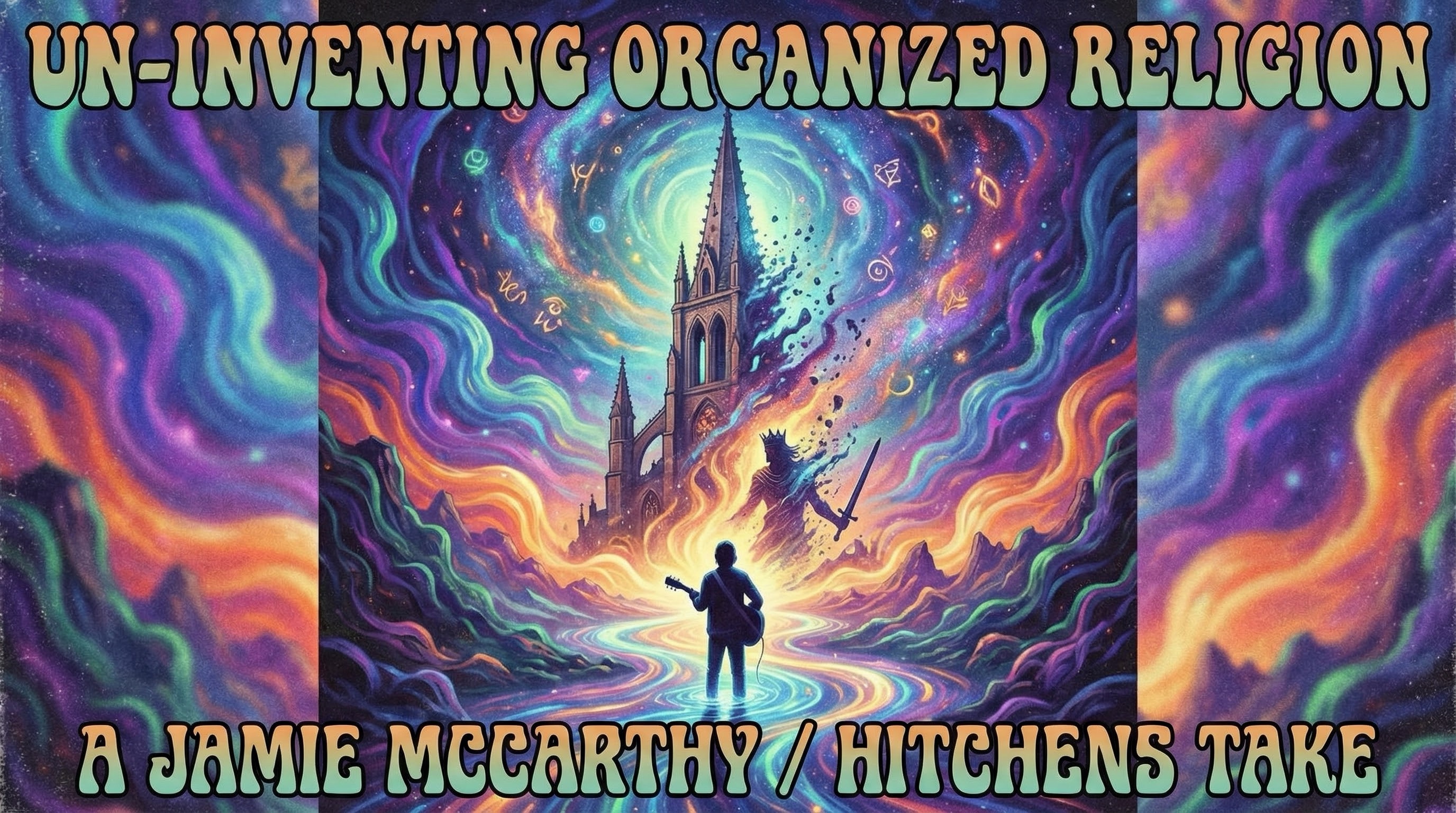
    If I had to un-invent Organized Religion, let’s be clear: I wouldn’t be trying to kill God. I’d be firing the middle management.

    I would dissolve the corporation of faith. Because that is what it has become: a global franchise that sells you water while you’re standing knee-deep in a river.

    There is a profound difference between the spiritual impulse—that raw, undeniable feeling you get when you write a lyric that tells the truth, or when you sit in silence and actually face your own Jungian shadow—and the rigid structures that demand you outsource your conscience.

    Hitchens would call it a “celestial dictatorship,” and he’d be right. It is the ultimate Orwellian surveillance state. It demands we surrender our modern intellect to the whims of bronze-age provincials. It insists we take our moral cues from illiterate merchant warlords who solved their disputes with the sword and claimed divine permission for their questionable domestic arrangements.

    Why should the messy, beautiful search for meaning be held hostage by the egos of men who have been dust for a thousand years?

    If we un-invented the organization, we wouldn’t be left with nothing. We would be left with us. We would be forced to build our own moral architecture, brick by brick, based on empathy and reason rather than fear. We would have to find the divine in the faces of the people we love—and the people we mourn—rather than looking for it in a gilded cage.

    True spirituality requires bravery. It requires the guts to walk into the dark without a map. Organized religion is just selling you a flashlight with dead batteries and telling you it’s the sun.