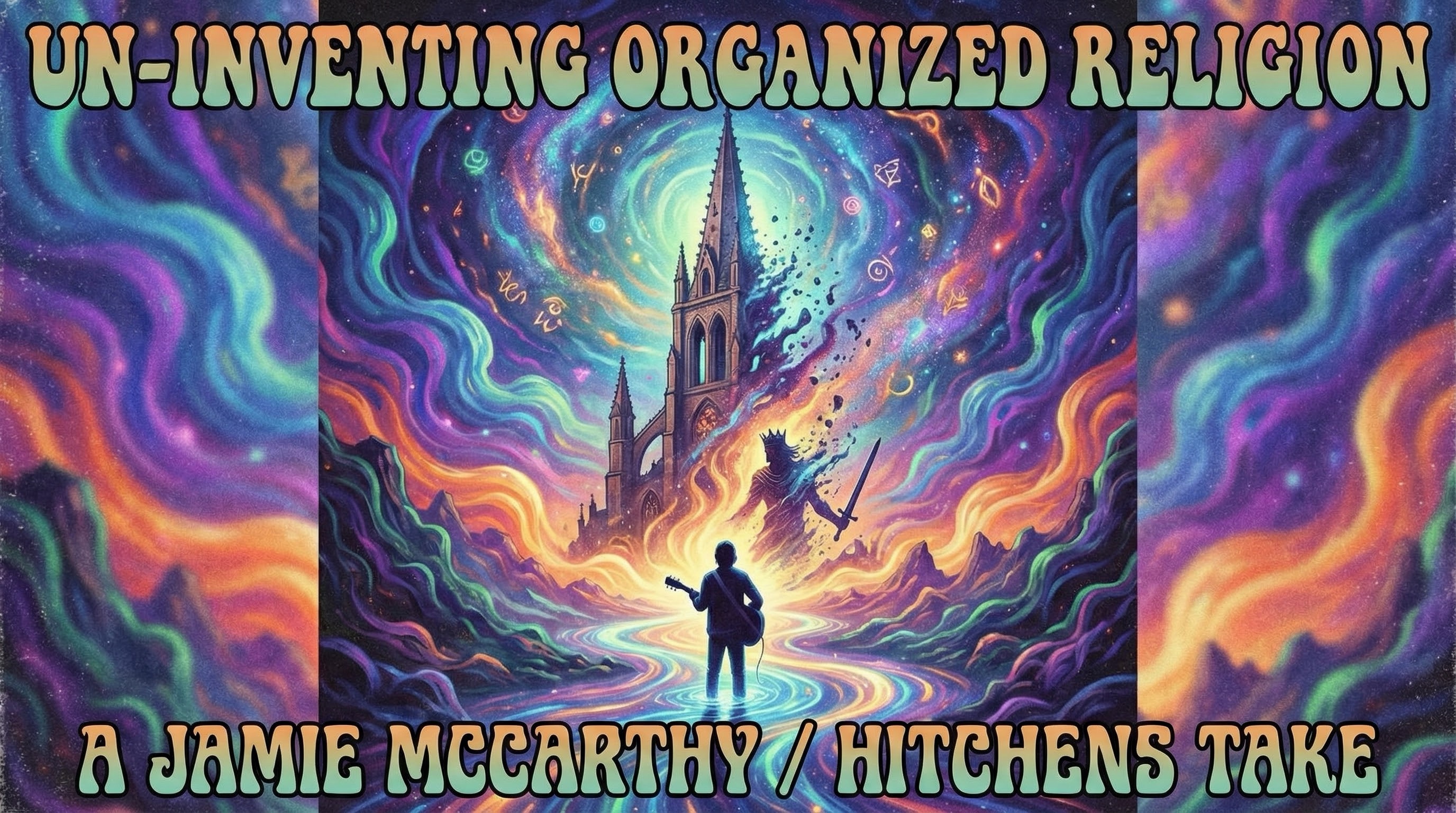
If you could un-invent something, what would it be?
If I had to un-invent Organized Religion, let’s be clear: I wouldn’t be trying to kill God. I’d be firing the middle management.
I would dissolve the corporation of faith. Because that is what it has become: a global franchise that sells you water while you’re standing knee-deep in a river.
There is a profound difference between the spiritual impulse—that raw, undeniable feeling you get when you write a lyric that tells the truth, or when you sit in silence and actually face your own Jungian shadow—and the rigid structures that demand you outsource your conscience.
Hitchens would call it a “celestial dictatorship,” and he’d be right. It is the ultimate Orwellian surveillance state. It demands we surrender our modern intellect to the whims of bronze-age provincials. It insists we take our moral cues from illiterate merchant warlords who solved their disputes with the sword and claimed divine permission for their questionable domestic arrangements.
Why should the messy, beautiful search for meaning be held hostage by the egos of men who have been dust for a thousand years?
If we un-invented the organization, we wouldn’t be left with nothing. We would be left with us. We would be forced to build our own moral architecture, brick by brick, based on empathy and reason rather than fear. We would have to find the divine in the faces of the people we love—and the people we mourn—rather than looking for it in a gilded cage.
True spirituality requires bravery. It requires the guts to walk into the dark without a map. Organized religion is just selling you a flashlight with dead batteries and telling you it’s the sun.
Some of us were dumb enough to think we were chosen. Destined for greatness. I was one of those fools.
Then life swung for the skull—my father gone when I was just twenty-four, my son gone at nineteen. That’s the punchline. And I’m still here, scribbling like a clown juggling knives at his own funeral.
Every line I write turns to rope. And rope’s a funny bastard—you can climb it, you can hang from it. Lifeline and noose, same damn thing.
And here’s where I laugh at myself: I can’t stand writers who always find a way to make it about them. But don’t mistake this for that—this isn’t me making it about me. This is me making it about you, making it about me. That’s the kind of pretzel you twist into when you’ve got nothing left but your own shadow to wrestle with.
Greatness? That’s the carrot they dangle so you’ll chase yourself into the grave. The truth is simpler: I’m under the gallows, grinning through broken teeth, laughing at my own execution, and the only reason I keep writing is because hanging myself with my own words is the one thing I’ve ever done well.
she fucked 1,245 men in a day they called it empowerment i call it a goddamn endurance test with a participation trophy and a yeast infection
feminism? sure. if you can sell it if you can pose for it if you can fuck it and file a tax return after
they say women are free now but I’ve seen more chains in lace than I ever did in iron the old chains told you what you were these new ones whisper it in the middle of the night while you scroll, naked trying to be wanted by strangers who wouldn’t stop to piss on you if you were on fire
patriarchy? at least it was honest it said: “you’re mine.” now it says: “you’re free to degrade yourself however you see fit” and sends you a promo code for lube
this isn’t revolution it’s rebranding with lipstick, hashtags, and a ring light everyone’s selling their soul some just get better lighting
i miss the women who didn’t have to prove anything didn’t need 1,245 pricks to feel something didn’t scream liberation while crying after the 8th faceless man and another fake orgasm
but what the hell do i know i’m just a recovering drunk of 24 years I guess sobriety is watching freedom take its clothes off for tips…equality, my ass.
“Emotional Support Whiskey” by McCarthy (written on a bar napkin, signed in ketchup)
When the woman cuts in front of me at TSA, I don’t flinch. I picture her face-down in a Marriott pool, clutching a mimosa and a yoga mat. It’s not a murder fantasy. It’s a peace offering.
I am 47 and have cried in more parking lots than churches. A woman once told me I had “sad dad energy,” so I leaned into it— got a flannel, grew a beard, adopted a dog named Regret. We howl at sirens together.
A girl said she likes men who cook— so I made her a soufflé and ghosted myself. Poof. Gone. Left the oven on just in case.
She said I was “too intense,” so I sent her flowers with a card that just said: “RUN.”
Another said I reminded her of her ex. So I slept with her best friend and sent her ex a thank-you note.
When she stopped texting, I took up taxidermy. Now I stuff my feelings into squirrels with tiny hats. I tour the Midwest with them. We sell out in Omaha.
She wanted a man with a five-year plan. I told her I was more of a five-minute man— three of them spent wondering why I still talk to women who say things like “my truth” in a sentence. She left before the microwave hit zero. Good. I didn’t want to share my Hot Pocket anyway.
I don’t key cars. I don’t listen to Taylor Swift unless I’m trying to fake empathy. I don’t write sad-boy poetry on rooftops. I don’t chase closure— but I will send a $2 Venmo labeled “emotional damages” just to see if they flinch.
She told me I was emotionally unavailable. I told her I was emotionally under construction, but the crew quit, the permits expired, and Joy Behar took over middle management. Now my inner child gets interrupted every five seconds and accused of being problematic.
I’m not mad. I’m just tired. Tired of pretending every cup of coffee isn’t just a slow suicide in disguise.
But I’m still here. Still tipping 20%. Still flossing sometimes. Still saying “you too” when the waiter says “enjoy your meal.”
I don’t need closure. I need a burrito and a nap. And maybe someone to lie to me about the future while I pretend I’m not googling if dogs and squirrels can actually be friends.
I arrive in a haze of neon twilight, drifting into the celestial dive bar at the end of the universe. The air is thick with ghost-smoke and the scent of spilled whiskey dreams. Constellations glow faintly in cracked light fixtures. A cosmic jukebox in the corner plays a distant, crackling blues – each note a star dying quietly in the night. I take a breath I no longer need and step inside.
Shadows dance along the walls and tell stories, whispered in charcoal tones. In those flickering silhouettes, I catch fragments of my life: a boy (surely me) learning to ride a bike under a summer sun, a teenager (my son, Jack) going out the side door and mumbling, “going to Justin’s, be back by 11pm,” an old man (Dad) slumped in a chair watching his own funeral on C-SPAN. The shadows play them out in silence, a living scrapbook of regrets and love. I blink, and the images waft away like smoke rings.
At the bar, spirits with no eyes sit and sip from empty glasses. They toast to nothing and everything, blind gazes cast toward the glowing bottles that line the shelves like stained-glass saints. They don’t turn as I pass. We’re all orbiting our own stories out here—me, them, humanity.
In a cracked leather booth under a neon halo, Jack and Dad wait for me. Jack beams, all 19 years of him forever etched in that youthful frame. Dad gives a gruff, warm nod, his form flickering between the old man I held as he died and the vigorous father who once held me. My heart – or whatever I have now – aches with a complicated joy.
I slide into the booth. Jack’s eyes shine like wet streetlights. We collide in a hug that transcends time; I feel the strength of his teenage arms again and the undeniable reality of loss washes through me. “I’ve missed you, kid,” I manage to say, voice cracking like the jukebox vinyl. Jack just smiles wider and blinks back gleaming tears. Dad’s hand falls on my shoulder, solid and steady, and I realize I’ve missed him too – God, so much – the lump in my throat says what I can’t.
A bartender who speaks only in old voicemail messages shuffles over, his face a fuzzy outline like a detuned TV. He opens his mouth and a familiar voice spills out, tinny and warm: “Hey, it’s me. Just checking in on you. Give me a call when you can, okay?” My breath catches; it’s a voicemail from my mother. I broke the golden rule and went before she did. The bartender’s head tilts, awaiting our order, the message looping softly: “…just checking in on you…” Jack and Dad look to me, eyebrows raised.
I clear my throat, steady myself. “Three whiskeys, neat.”
My mother’s voice replies from the bartender’s lips: “I love you. I will always love you. Goodbye.” He nods and vanishes to fill our order, leaving me shaken and grateful all at once. It wasn’t my fault I went before Mom—it happened by chance. Or did it? Well, something like that.
I turn to Jack and tell him, “I finally got Miranda, but one of his thugs got me just as I finished the choke that stopped Miranda from breathing for good. I whispered in his ear as I dropped him, bag full of bones onto the concrete, ‘That was for Jack, and his mother, Samantha, God, and the universe.’ Then, boom. I was shot in the back of the head.”
Jack chuckles under his breath, as if he now is far wiser to the world than I am. He’s practically vibrating with excitement to have me here. He lifts one of the empty glasses already on the table, swirling the ghost of a drink. “Dad,” he grins, “it’s okay to drink here. Your sobriety on earth was a gift to the family and possibly the world.” There’s a light in his eyes—pride, mischief, reassurance. I let out a laugh, part joy and part disbelief. Of course my kid knows I’m conflicted about ordering whiskey after decades dry. Of course he’s giving me permission, here at the end of ends.
Dad snorts, easing himself into the booth further. With a teasing smile he turns to Jack, “Yeah, when he was your age he had a thirst for the grape like a mad sommelier on acid plus a case of ’69 Château Latour.” Jack bursts out laughing and I groan, running a hand through my hair. “Always there to make sure I stay humble, huh Dad?” Generational friction follows us even into death, it seems. Dad just winks. “Just keeping my promise that you never forget the importance of being grounded.”
Our drinks appear as the bartender returns, sliding three glasses toward us with a crackle of another old voicemail: “You have… one new message.” This time the voice is my own, it’s more recent, shaky: “Jack… I just wanted to say I’m sorry, I was supposed to protect you, and I failed. I love you.” A message I left on Jack’s phone the day after he died – when I finally understood him. Dad’s eyes brim as he hears it, and he reaches for his glass. The bartender fades back into the haze before the message can finish.
We raise our glasses. The whiskey’s color is deep gold, catching the neon like liquid sunlight. I hesitate, the old instinct of sobriety warring with the desire to join my son in this toast. Jack clinks his glass to mine – the sound rings like a small bell in the quiet chaos of the bar. Dad follows, his large hand swallowing his glass. “To family,” Jack offers, voice soft now. “To second chances,” I add, my throat tight. Dad rasps, “To life… and what comes after.”
We drink.
The whiskey tastes of memory – rich and smoky, with notes of laughter and decades of shared sorrow. It burns going down, but warmly. I feel a weight lift that I didn’t know I was still carrying.
A neon sign sputters above us, casting a gentle glow over Jack’s face. I see the man he never got to become and the boy he always will be. “I’m sorry I couldn’t save you,” I whisper, the words falling out before I can catch them. My vision blurs. Jack sets his glass down and takes my hand – his touch is solid, forgiving. “It wasn’t your fault, Dad,” he says quietly. “I got more love in 19 years than some do in a hundred. You gave me that.” His words are a balm I didn’t know I needed. I squeeze his hand, a tear finally escaping down my cheek. In this bar of ghosts and cosmic light, I can cry freely; each tear turns to stardust in the blue glow.
Dad clears his throat, emotion thick in the air. In true Dad fashion, he deflects the heaviness with a gentle joke: “Well, Jack, your old man sure took his sweet time getting here. We were starting to think he’d stand us up.” I chuckle, wiping my eyes. “Sorry to keep you waiting,” I quip. “Traffic through Mexican Town was hell.” Jack and Dad both groan at the obvious reference to Jack’s and my own demise, and for a moment we’re just three idiots laughing at the edge of eternity.
The cosmic jukebox shifts tunes, and now it plays something low and familiar – a song I recognize as the one that played on the radio the night Jack was born. The melody drifts through the bar like a comet’s tail. I catch a woman made of Polaroids swaying gently to the music near the jukebox. Her form is a collage of photographs, each snapshot a piece of someone’s story. As she twirls, I glimpse a Polaroid of a hospital room – my wife in bed holding a newborn Jack, both exhausted and radiant. Another flash: a photo of me at twelve, baseball glove in hand, Dad standing behind me proud and tall. My breath catches. The woman’s eyes meet mine and she offers a knowing smile before the music carries her into another slow spin. I realize these photos are pieces of my life. She is made of moments I lived, and moments I missed. My heart clenches with a strange nostalgia. In her, I see the totality of my story dancing in one body.
Jack nudges me and nods toward the bar counter. There, a preacher made of smoke has materialized, nursing a drink that evaporates within him. His face is a swirling mist of sermon and ash. He raises a translucent finger and intones in a vaporous drawl, “Sometimes, you have to care enough to know not to care too much,” which floats through the air like incense. Then he dissolves into a curl of smoke, leaving only the faint echo of a hymn. It’s oddly comforting – a reminder that even old dogmas and worries have become specters here, powerless, fading.
Dad shakes his head. “He was always long-winded, plus I’m the one who said that to you when you were 19,” he mutters, and Jack snickers.
We trade stories – not of what was, but what is now. Jack talks about the friends he’s made in this in-between bar, how he’s become something of a pool shark (he gestures to a table where a one-armed ghost and a translucent librarian cheer as a trick shot sinks). Dad recounts with a chuckle how he tried giving the preacher a cigar, just to see him billow. I find myself laughing more freely than I have in years. The sound feels good. Honest.
In a lull, I admit softly, “I was scared to see you both again… afraid you’d be disappointed in me.” It’s out before I can stop it – that raw vulnerability. Jack’s brow furrows in disbelief. “Disappointed? In you?” he says. “Dad… I’ve always been proud of you. Even when I was a stubborn teen and acted like I wasn’t.” Dad nods vigorously. “Son, we’ve both always been proud. You broke cycles, you loved us hard, you lived as best you could. Why would we be anything but grateful?” I bite the inside of my lip to keep it from trembling. This absolution, this love laid bare – it’s more than I ever hoped to earn.
Above us, the neon light buzzes, the color of sunrise. The bar around us hums with its own quiet tales: those eyeless spirits clink glasses and mutter farewells to old pains; the Polaroid woman’s laughter sounds like a shutter click as she trades snapshots with a faceless man in a WWII uniform; the jukebox planets continue their slow orbit through melodies.
Jack stands, grabbing our empty glasses. “Another round?” he asks, already heading toward the bar. Dad slides out after him, patting my back as he goes. “Be right back, son.” I watch them weave through the crowd of memories and phantoms. My father, my child – two bookends to my life, moving with an ease that eluded us in the living world. I take this moment alone to breathe it all in. This absurd, beautiful dive bar of the afterlife has given me something precious: time – time to say what was left unsaid, to laugh at jokes that had been silenced by years, to forgive and be forgiven.
Jack returns carrying three fresh glasses, amber liquid sloshing. The bartender must have delivered them in another recorded phrase, but I was too lost in thought to catch which memory he used. No matter. We gather by the old jukebox now, leaning against it as cosmic light spills like rainbows across the scuffed floor.
“Remember this one?” Dad asks as a new song begins – it’s his favorite tune, the one he used to hum while getting ready to go on the air: You Make Me Feel So Young. He takes Mom’s old Polaroid from the dancing woman’s hand (she giggles and drifts away, leaving that photo behind as a gift). In the picture, Dad and I are standing at the Jupiter Inlet, holding up bluefish, both smiling. Dad slips the Polaroid into his shirt pocket with a satisfied grin. Jack wraps an arm around my waist, and I drape mine over his shoulders. Three generations, side by side in a bar at the end of the world, listening to the music of the spheres.
I raise my glass, and they follow suit. No need for a toast this time – the moment speaks for itself. Our glasses touch, and the sound is like the final chord of a favorite song, resolving at last. We drink deep. The warmth fills us.
In this strange, smoky liminal space, we remain – laughing, loving, healing. The celestial dive bar doors stay open for as long as we need. And as another cosmic record drops into place – Lush Life, sung by Nat King Cole – I know our story isn’t over. We found each other again. We have found peace.