You were funny and reckless and loyal and stubborn and alive in that enormous way young men are alive when they still believe there is an endless supply of tomorrow.
You should be 24 now.
There should be more photographs. More bad decisions. More stories I haven’t heard yet.
More Jack and Dad concerts, UFC Events, and more “I love you, Jackie—“I love you too, Dad” More people who know you who haven’t even met you yet.
Instead, there is this strange arithmetic the world expects us to accept:
September 25, 2021.
Five years.
As though time has anything to do with it.
I don’t want today to be about how Jack died.
I want it to be about the fact that Jack lived.
He walked into rooms. He made people laugh. He pissed people off. He loved. He fought. He had plans. He had terrible ideas. He had good ones.
He had magical energy, if you knew him, you know.
He was somebody’s friend. Somebody’s teammate. Samantha’s brother. Kathy’s son. My son.
He was here.
He was HERE.
And nineteen years of a human life should never be reduced to the worst few minutes of it.
So I won’t give those minutes any more of him today.
I’ll just say this:
I remember everything.
Including the name of the person who put that poison in his hands.
But that name doesn’t belong here.
This space belongs to Jack.
It always will.
Jack McCarthy March 16, 2002 — September 25, 2021
Still loved. Still spoken. Still here in every way that matters.
the preacher on the corner had bad teeth and smelled of old cabbage and Easter eggs.
he told us about streets of jasper and some big boss who loved us long as we kept our heads down and didn’t steal the copper wire.
bullshit, I told him.
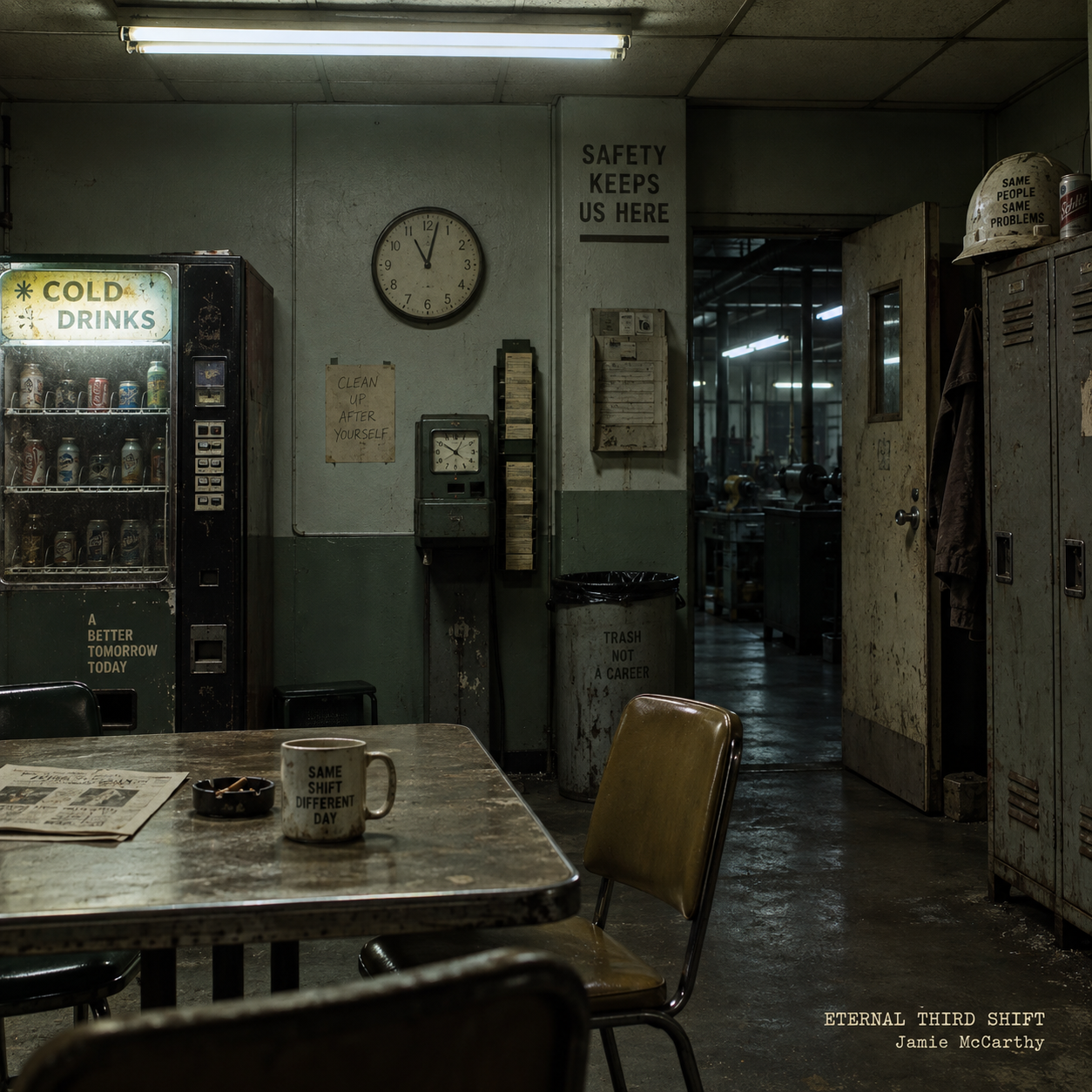
if there’s a heaven for guys with grease under their nails, it’s just the eternal third shift—
a damp basement under the stars where the fluorescent tubes buzz, dying flies on fire in light that never quite turns white.
you punch a tarnished brass clock at 11:03 p.m. for all of eternity.
no time-and-a-half.
no foreman either,
just the ghost of an old bastard named Henderson leaning against a broken vending machine, smoking generic menthols and telling you the union rep drowned in a vat of starch back in ’64.
the harp music is just a radio stuck between two Spanish stations and static.
you wipe down the lathe with an oily rag.
your knees ache with the same dull thud you bought on earth for six bucks an hour,
and the coffee in the pot has been boiling since the fall of Rome.
nobody gets fired.
nobody gets to go home.
the angel at the gate wears a stained apron and hands you a clipboard with a grievance form that’s missing the bottom half.
“sit down,” he says, spitting into an empty Schlitz can.
It was never mysterious. It was never chemical, spiritual, accidental, inconvenient, or capable of surviving a bad haircut.
It was simply a marketplace waiting for sufficiently damaged people to develop the correct terminology.
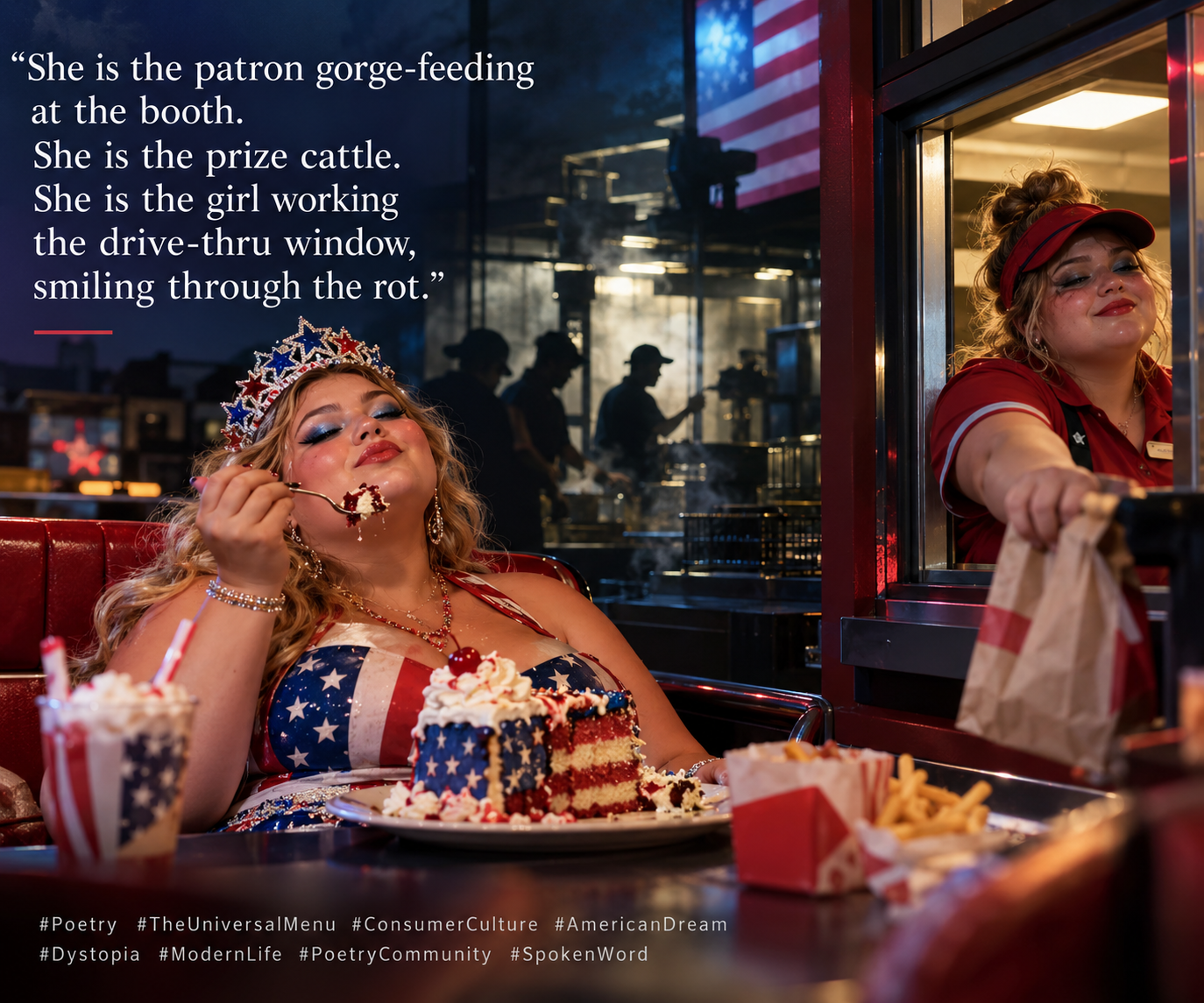
Today, every man and woman can determine their romantic worth using a few universally accepted measurements. For men: height, income, abdominal visibility, automobile, professional status, and the ability to remain emotionally motionless while someone explains why her beauty is a full-time contribution to the household.
For women: youth, symmetry, waist-to-hip ratio, sexual desirability, social reach, and the ability to stare confidently into a camera while saying, “I know my worth.”
Once these figures have been entered, the human being may be assigned a value.
Not a price, obviously.
A value.
Prices would make the whole thing sound vulgar.
I recently watched a podcast devoted to this new science of human appraisal. Two men, both considered “high value,” sat on a panel while several women described the qualifications necessary for a man to be permitted into their lives.
He should be at least six feet tall.
He should make a considerable amount of money.
He should pay for everything.
He should provide security, travel, housing, leadership, protection, emotional stability, stimulating conversation, unwavering confidence, romantic spontaneity, and sufficient free time to make her feel prioritized despite the career necessary to finance the operation.
He should treat her like royalty, although nobody clarified which monarchy or whether the peasants remain responsible for utilities.
The host listened with the grave concentration of a central banker.
He did not laugh.
He did not overturn the table.
He did not ask whether everyone in the room had suffered a recent head injury.
Instead, he asked one of the women a question.
“What value do you bring?”
Not Who are you?
Not What do you love?
Not What have you survived?
Not What makes you laugh when nobody important is watching?
Value.
Please describe your assets.
Disclose any liabilities.
Previous owners may appear in the comments.
She explained that she was beautiful. She might work if she felt like working, but her high-value man would generally take care of everything.
Fair enough.
Employment, in this arrangement, is regarded much like watercolor painting or dressage: an enriching personal pursuit that should never interfere with being completely maintained by somebody else.
When asked what she brought to the relationship, she essentially gestured toward herself.
The market applauded.
The men, meanwhile, admitted that they did not particularly care whether a woman possessed money, professional competence, ambition, or a functioning relationship with reality.
They had apparently spent years becoming high value so they could acquire the human equivalent of expensive patio furniture.
And everyone called this “standards.”
Nobody called it what it was: two forms of emptiness agreeing on a payment schedule.
The term high value is ingenious because it makes avarice sound like character.
The high-value man need not be wise, kind, funny, curious, loyal, or capable of sitting beside another human being in pain.
He must be solvent.
He is a benefits package with shoulders.
He is expected to produce income, protection, housing, social status, restaurant reservations, competent plumbing decisions, and the continued absence of financial consequence. He must be dominant but never controlling, vulnerable but never weak, successful but always available, dangerous enough to be exciting but domesticated enough to approve the vacation itinerary.
He is not a person.
He is infrastructure.
The high-value woman, in return, need not be interesting, accomplished, generous, resilient, or particularly awake.
She must remain visually desirable.
She is a luxury good capable of explaining why she deserves luxury goods.
She provides beauty, youth, sexual desirability, social proof, carefully manufactured spontaneity, and—should the spirit move her—the possibility of employment.
She is not a person.
She is ornament.
He is valued for what he can provide.
She is valued for what she can provoke.
They call this knowing what they deserve.
Nobody in the room was discussing love. They were negotiating access.
It may be a perfectly voluntary arrangement.
So is leasing a Lexus.
Just don’t call the dealership a cathedral.
The men advertise their wealth and then become furious when women arrive with calculators.
The women advertise their beauty and then become furious when men behave like customers.
Every participant is offended that the other side believed the advertisement.
The man says his money is evidence of discipline, intelligence, masculinity, and personal worth. The woman says her beauty is evidence that she deserves access to it.
He wants to be loved for himself while leading with his bank account.
She wants to be loved for herself while describing herself as a visual experience.
He resents being treated like an ATM.
She resents being treated like a body.
Neither seems willing to remove the merchandise from the window.
This is what passes for empowerment now: selecting the terms of your own objectification.
We have taken the oldest transaction in human history, put it beneath flattering studio lights, added wireless microphones, and renamed it personal development.
The participants no longer use crude language because crude language might reveal the crudeness of the arrangement. They speak instead of “mindset,” “masculine energy,” “feminine energy,” “abundance,” “submission,” “provision,” “access,” “standards,” and “the lifestyle I deserve.”
It is procurement wearing spiritual cologne.
The podcast host serves as auctioneer, therapist, economist, and parish priest. He solemnly asks everyone to explain their market position, then nods as though Aristotle has returned from the grave to rank women by follower count.
Nobody asks the impolite questions.
Can you apologize without explaining why you were technically right?
Can you remain when somebody gets sick?
Can you make a hospital room less frightening?
Can you be trusted with an unflattering truth?
Can you survive an ordinary Tuesday without needing strangers to envy you?
Can you sit quietly beside someone whose grief cannot be fixed?
Can you love a body after illness, childbirth, surgery, age, medication, gravity, and time have revised the original agreement?
Can you lose your job without losing your identity?
Can you be poor together for six months?
Can you be afraid without becoming cruel?
Can you carry another person for a while without keeping an invoice?
No?
But you’re six-foot-two and she has exceptional bone structure?
Congratulations.
The market has cleared.
This entire high-value framework depends upon a terror of ordinary humanity.
An actual person is a dangerous investment. An actual person gets older, gains weight, loses money, develops scars, changes direction, becomes depressed, says the wrong thing, needs help, disappoints you, surprises you, and occasionally stands in the kitchen at 2:00 in the morning eating shredded cheese directly from the bag.
An actual person cannot maintain brand consistency.
Better to purchase a category.
A provider.
A trophy.
A protector.
A princess.
A six.
A ten.
A millionaire.
A model.
A symbol that can be displayed to other frightened people as evidence that you have won.
Because this is not ultimately about finding love.
It is about being seen receiving something other people want.
The man acquires the beautiful woman so other men will understand his rank.
The woman acquires the wealthy man so other women will understand hers.
They stand beside each other like trophies that have agreed to dust one another.
Perhaps they are happy.
People have built successful lives upon stranger arrangements.
But happiness seems almost beside the point. The relationship’s primary function is not to nourish the people inside it. Its function is to communicate value to the people outside it.
Even intimacy has become a press release.
And beneath all this talk of value is the quiet implication that most human beings do not have very much.
The schoolteacher is low value.
The mechanic is low value.
The single mother is low value.
The five-foot-eight man caring for his dying father is low value.
The woman whose body has carried three children and twenty years is low value.
The warehouse worker reading Dostoevsky on his lunch break is low value.
The recovering addict who has remained sober long enough to become trustworthy again is low value.
The man on the mower thinking about God is low value.
None of them has been sufficiently optimized.
None photographs particularly well beside a rented Lamborghini.
I would rather spend an afternoon with any one of them.
I would rather talk about mortality with a man shining a shoe than listen to another professionally groomed mannequin describe the minimum income required to experience her personality.
I want to hear what the mechanic thinks happens when we die.
I want to know what the schoolteacher has learned from children.
I want to know why the man cutting the grass still believes in God—or why he stopped.
I want to know which song the exhausted nurse plays on the drive home.
I want to know what kept the addict alive on the night he nearly wasn’t.
These people may not be high value.
They are merely valuable.
Which is to say they possess interior lives that cannot be itemized, ranked, filtered, monetized, or entered into a dating application without destroying the very thing that makes them worth knowing.
A human being is not valuable because the market selects them.
A human being is valuable because there are things inside them no market could possibly measure.
Humor.
Mercy.
Curiosity.
Endurance.
Loyalty.
Contradiction.
The courage to remain.
The willingness to forgive.
The ability to sit beside another person in the dark without immediately turning on a ring light.
The supposedly high-value people have built an entire philosophy of human worth from which nearly every valuable human quality has been removed.
And that may be the greatest achievement of the modern marketplace.
It has finally taught us how to know the price of everyone—
There is a particular architecture to this part of town.
The fire escapes aren’t there to save anyone.
They’re there to hold up the shadows.
On every corner, the devil dogs are waiting.
Demonic little bastards with gold teeth and neon eyes, selling pieces of salvation wrapped in tin foil, lining the curbs like gargoyles in cheap leather jackets.
You’d think darkness would swallow everything whole.
You’d think the weight of it would collapse the lungs of anything still trying to breathe.
Then you see her.
She didn’t descend from some celestial cloud.
There were no trumpets.
No holy light clearing the way.
She arrived.
Busted up, but not broken.
Looking like she’d been dragged through three different levels of someone else’s nightmare and somehow walked back out.
Her wings aren’t pristine white. They’re jagged poetry stitched together with scar tissue, feathers matted with street oil, soot, and sweat.
She looks like hell.
Her spirit doesn’t.
Deep in the alley, where a dead tree forces itself through cracked brick like a broken rib, she finds a place to perch.
The devil dogs gather below.
They hiss.
Throw stones.
Flash their knives beneath the neon.
She doesn’t move.
She watches them the way mountains watch weather.
Unfettered.
A creature no gatekeeper would recognize, carrying something no devil can counterfeit.
You can break the bone.
You can clip the edges.
You can grind every bright color into a bruised gray.
There was a time when asking someone for two uninterrupted minutes of attention was a modest request. Today, it borders on hostage-taking.
The evidence is not merely anecdotal. Human attention has not wandered off for a cigarette and promised to return. It has collapsed in broad daylight while we all watched.
The average person now grants a piece of content roughly 8 seconds before rendering judgment. Teenagers switch between applications every 44 seconds. Less than half of viewers survive the first minute of a video, regardless of its length. Only a small fraction remain standing by the final ten seconds. The first thirty seconds are not an introduction anymore; they are a battlefield littered with casualties.
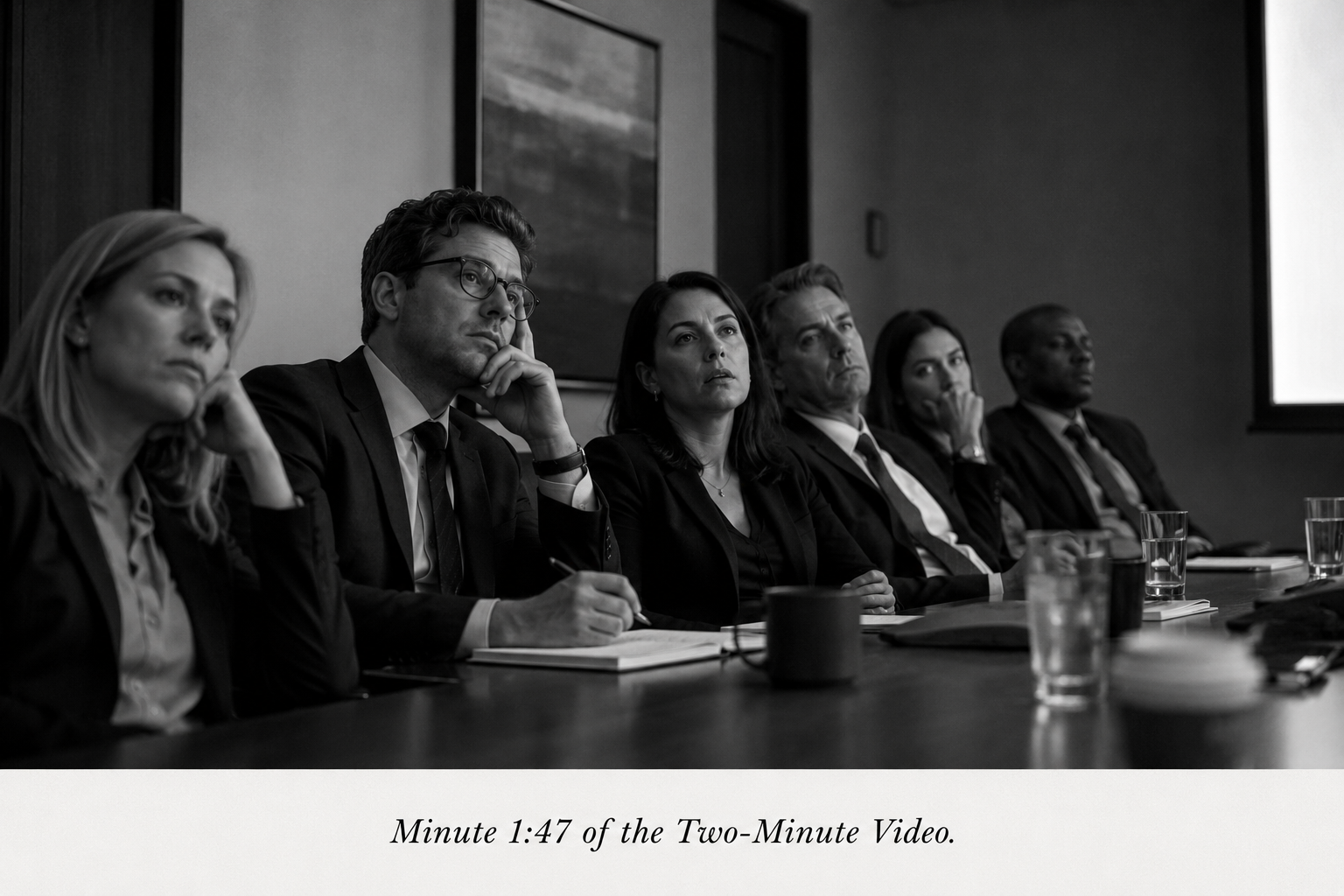
Yet every week, somewhere in a conference room with poor coffee and an abundance of PowerPoint slides, someone proposes a two-minute B2B video.
This is usually justified by invoking seriousness.
“It’s business-to-business.”
“It needs more detail.”
“We have a lot to say.”
No, it doesn’t.
What it has is a lot of things that nobody was willing to cut.
The notion that professionals suddenly transform into patient scholars when seated at a laptop on a Tuesday afternoon is one of the more charming delusions of modern marketing. The procurement manager watching your video is the same human being who spent the weekend scrolling through TikTok at six-second intervals. The brain does not enter a special “corporate patience mode” simply because the viewer’s badge works at an enterprise software company.
The numbers are merciless. Viewers decide within seconds whether something deserves their attention. Slow openings lose a majority of the audience almost immediately. Average retention rates across video platforms are, frankly, horrific. Long-form consumption continues its slow decline while multitasking rises and content exposure explodes.
In other words, the audience has spoken. Repeatedly. Loudly.
What remains fascinating is the industry’s refusal to listen.
There is, of course, one notable exception. People will watch long-form content from creators they trust. Devoted audiences routinely spend hours with their favorite podcasters, commentators, and personalities.
The operative word is earned.
A beloved creator can ask for two hours because they have spent years earning that privilege. A corporate brand unveiling its latest fleet management solution has not.
Confusing the two is like mistaking a first date for a golden anniversary.
The deeper issue, however, is not effectiveness. It is respect.
Every unnecessary second in a video represents a small act of arrogance. It assumes the audience’s time is less valuable than the creator’s desire to explain. It suggests a lack of confidence in the message itself. The longer the video becomes, the more it begins to feel like a negotiation with uncertainty.
Brevity is not the enemy of intelligence.
Brevity is evidence of it.
A concise video communicates something powerful: we know what matters, we know what doesn’t, and we trust you to understand the difference.
Nobody remembers the two-minute explainer.
They remember the thirty-second piece that made them feel something, understand something, or see something differently.
The purpose of communication is not to exhaust a subject. It is to illuminate it.
Everything after that is often just vanity wearing a lanyard.