Tag: jamiemccarthy

  • The Man Who Said it.

    What is your favorite quote?

    My favorite quote has never been one from a famous author.

    It came from my father:

    “Sometimes you have to care enough to know not to care too much.”

    I’ve found myself repeating it throughout my life.

    As I’ve gotten older, I’ve realized it wasn’t about caring less. It was about caring deeply—without letting the outcome consume you. Whether it’s sports, music, work, or life itself, the moment you become too attached to winning, proving yourself, or getting it perfect, you often lose the very thing that got you there.

    The older I get, the wiser his words become.

    I’m grateful they were his.

  • SHE ARRIVED

    SHE ARRIVED

    There is a particular architecture to this part of town.

    The fire escapes aren’t there to save anyone.

    They’re there to hold up the shadows.

    On every corner, the devil dogs are waiting.

    Demonic little bastards with gold teeth and neon eyes, selling pieces of salvation wrapped in tin foil, lining the curbs like gargoyles in cheap leather jackets.

    You’d think darkness would swallow everything whole.

    You’d think the weight of it would collapse the lungs of anything still trying to breathe.

    Then you see her.

    She didn’t descend from some celestial cloud.

    There were no trumpets.

    No holy light clearing the way.

    She arrived.

    Busted up, but not broken.

    Looking like she’d been dragged through three different levels of someone else’s nightmare and somehow walked back out.

    Her wings aren’t pristine white. They’re jagged poetry stitched together with scar tissue, feathers matted with street oil, soot, and sweat.

    She looks like hell.

    Her spirit doesn’t.

    Deep in the alley, where a dead tree forces itself through cracked brick like a broken rib, she finds a place to perch.

    The devil dogs gather below.

    They hiss.

    Throw stones.

    Flash their knives beneath the neon.

    She doesn’t move.

    She watches them the way mountains watch weather.

    Unfettered.

    A creature no gatekeeper would recognize, carrying something no devil can counterfeit.

    You can break the bone.

    You can clip the edges.

    You can grind every bright color into a bruised gray.

    But there is a current underneath all of it.

    Something that never agreed to belong to gravity.

    The gutter reflects the neon.

    The monsters wait.

    She opens what’s left of her wings.

    The demons look up.

    Gravity loses the argument.

  • Proof Of Use

    Proof Of Use

    What do you love now, that you hated when you were younger?

    When I was young, I thought everything worth loving had to announce itself.

    Loud music.
    Fast cars.
    People with big personalities.
    Cities that never slept.

    I mistook volume for importance.

    Now I love things that barely make a sound.

    The first cup of coffee before the house wakes up.

    An old diner where nobody has updated the menu because nobody needed to.

    The click of a turn signal on a truck that’s been working longer than most people have been alive.

    Silence doesn’t feel empty anymore.
    It feels earned.

    I used to hate old people telling stories I’d already heard.

    Now I’d give just about anything to hear a few of them one more time.

    I hated wrinkles.

    Now I think smooth skin just means the book hasn’t been read yet.

    I hated slow.

    Now I understand that almost everything worth remembering happened slowly.

    Trust.

    Love.

    Recovery.

    Forgiveness.

    Even grief.

    Especially grief.

    When you’re young, you think life is made from extraordinary moments.

    Turns out it’s mostly Tuesday mornings.

    It’s grocery stores.

    Neighbors waving.

    Your daughter calling.

    Finding your son’s old coffee cup still tucked behind a stack of cereal boxes because nobody had the heart to move it.

    The older I get, the less interested I am in things trying to look new.

    Give me cracked leather.

    Faded motel signs.

    Paint peeling from a porch.

    The waitress who already knows what I’m ordering.

    The guitar with the finish worn off where someone’s arm rested for twenty years.

    Things that have survived become beautiful.

    Maybe that’s what changed.

    When I was younger, I admired perfection.

    Now I admire endurance.

    The truth is, I don’t think I love different things now.

    I think I finally understand what they were trying to tell me all along.

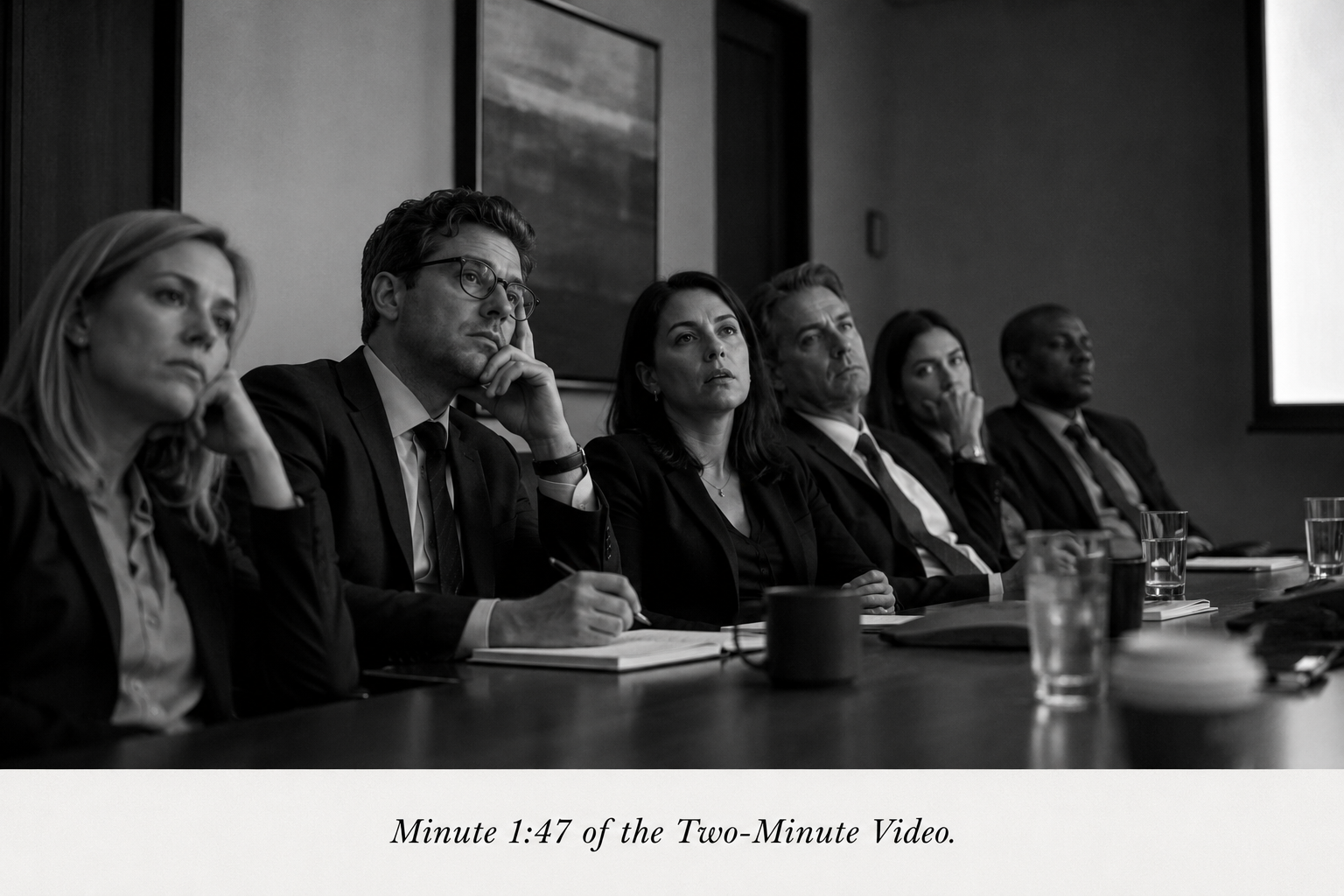
  • The Cruelty of the Two-Minute Video

    The Cruelty of the Two-Minute Video

    There was a time when asking someone for two uninterrupted minutes of attention was a modest request. Today, it borders on hostage-taking.

    The evidence is not merely anecdotal. Human attention has not wandered off for a cigarette and promised to return. It has collapsed in broad daylight while we all watched.

    The average person now grants a piece of content roughly 8 seconds before rendering judgment. Teenagers switch between applications every 44 seconds. Less than half of viewers survive the first minute of a video, regardless of its length. Only a small fraction remain standing by the final ten seconds. The first thirty seconds are not an introduction anymore; they are a battlefield littered with casualties.

    Yet every week, somewhere in a conference room with poor coffee and an abundance of PowerPoint slides, someone proposes a two-minute B2B video.

    This is usually justified by invoking seriousness.

    “It’s business-to-business.”

    “It needs more detail.”

    “We have a lot to say.”

    No, it doesn’t.

    What it has is a lot of things that nobody was willing to cut.

    The notion that professionals suddenly transform into patient scholars when seated at a laptop on a Tuesday afternoon is one of the more charming delusions of modern marketing. The procurement manager watching your video is the same human being who spent the weekend scrolling through TikTok at six-second intervals. The brain does not enter a special “corporate patience mode” simply because the viewer’s badge works at an enterprise software company.

    The numbers are merciless. Viewers decide within seconds whether something deserves their attention. Slow openings lose a majority of the audience almost immediately. Average retention rates across video platforms are, frankly, horrific. Long-form consumption continues its slow decline while multitasking rises and content exposure explodes.

    In other words, the audience has spoken. Repeatedly. Loudly.

    What remains fascinating is the industry’s refusal to listen.

    There is, of course, one notable exception. People will watch long-form content from creators they trust. Devoted audiences routinely spend hours with their favorite podcasters, commentators, and personalities.

    The operative word is earned.

    A beloved creator can ask for two hours because they have spent years earning that privilege. A corporate brand unveiling its latest fleet management solution has not.

    Confusing the two is like mistaking a first date for a golden anniversary.

    The deeper issue, however, is not effectiveness. It is respect.

    Every unnecessary second in a video represents a small act of arrogance. It assumes the audience’s time is less valuable than the creator’s desire to explain. It suggests a lack of confidence in the message itself. The longer the video becomes, the more it begins to feel like a negotiation with uncertainty.

    Brevity is not the enemy of intelligence.

    Brevity is evidence of it.

    A concise video communicates something powerful: we know what matters, we know what doesn’t, and we trust you to understand the difference.

    Nobody remembers the two-minute explainer.

    They remember the thirty-second piece that made them feel something, understand something, or see something differently.

    The purpose of communication is not to exhaust a subject. It is to illuminate it.

    Everything after that is often just vanity wearing a lanyard.

  • Stuck In The Elevator

    Don’t Panic

    Real is rare
    rarely there
    in the polluted saluted
    sleep-tight sludge-fucker world

    smile-fuckery handshakers
    marionettes needled to their knuckles

    prefabricated friction
    created to fake out frauds
    lost in the empty lie-down crowd

    where is God?
    stuck in the elevator of his own creation

    take the ventilator out
    breathe your own fire

    into the chaos

  • Tailored by Damage

    What’s the oldest things you’re wearing today?

    We earn what’s worn.

    What’s the oldest thing I’m wearing today?

    Not the boots.
    Not the jacket.
    Not the watch pretending time means anything.

    It’s the uneasy stomach.
    The golf ball lodged in the throat.
    The cracked heart stitched together with bad sleep, caffeine and whatever people call “moving on.”

    Those are old.
    Ancient, really.

    Hand-tailored over years by loss, disappointment, memory, guilt, love and the quiet observations you never talk about out loud because everyone else is busy performing wellness like it’s an Olympic sport.

    I wear old conversations that never ended properly.
    Old funerals.
    Old versions of myself I buried but still hear scratching around under the floorboards at 2 a.m.

    None of it was designed by me.

    It was made for me.

    By every slammed door.
    Every hospital hallway.
    Every “I’m fine” that wasn’t.
    Every moment you realized the world keeps spinning with horrifying confidence no matter what it takes from you.

    That’s the oldest thing I’m wearing today.

    And somehow, against all logic, it still fits.

  • The Inheritance


    We were given names for things
    long before we knew how to question them.

    [PAGE 1]

    They handed it to us early.
    Before we had the language to question it.

    A name.
    A color.
    A place to stand.

    Not chosen.
    Just… assigned.


    [PAGE 3]

    You grow into it.

    Like a scar—
    tight at first,
    then normal,
    then invisible.

    Until someone presses on it.


    [PAGE 7]

    It’s strange, the way we inherit distance.

    Same coffee.
    Same tired eyes.
    Same quiet fear about time slipping.

    Still—
    not the same.

    So you start looking for proof.


    [PAGE 11]

    Skin becomes signal.
    Language becomes warning.
    God becomes territory.

    No one says it outright.

    They don’t have to.


    [PAGE 18]

    The program was never loud.

    It lives in the small things—
    the glance,
    the pause,
    the almost-word.

    Passed down like something sacred
    no one remembers buying.


    [PAGE 26]

    Religion—
    the version we were handed—

    Feels less like a door
    and more like a fence.

    Different names for the same sky.
    Different rules for the same dust.


    [PAGE 31]

    Every now and then
    it slips.

    A conversation that works when it shouldn’t.
    A laugh that ignores the lines.

    For a second—
    none of it exists.


    [PAGE 32]

    But it comes back.

    Because seeing it
    doesn’t mean you’re free of it.

    It waits
    in your first reaction.

    Proof it was built deep.

  • FRAGMENTS FROM A MAN WHO WALKED BACK

    What book could you read over and over again?

    Some pages missing
    If that’s what crazy is than I’m as far gone down the road wacko as it gets”

    Thought I was him once.

    Randle P. McMurphy
    laughing too loud
    pushing too hard
    mistaking noise for control.

    Turns out—

    you can rattle a cage so long
    you forget
    you’re still inside it.

    Did my time near the edge.

    Not a metaphor.

    Real enough
    that I still catch myself scanning rooms
    for exits
    I don’t need anymore.

    There’s a taste to it.

    Not freedom.
    Not power.

    Something… cheaper.

    Easy to confuse the two
    when you’re young
    or angry
    or both.

    Watched a few go over.

    Didn’t come back.

    Still walking.
    Still talking.

    Nothing behind the eyes
    but compliance dressed up as calm.

    One of them smiled at me once—
    like he recognized something.

    I still don’t know
    which side of the glass he thought I was on.

    I came back.

    Not proud of it.
    Not ashamed either.

    Just… done.

    People call it discipline.

    Feels more like
    recognition.

    You see the line once
    you don’t need to test it every day.

    I can still go there.

    That’s not gone.

    Just… unnecessary.

    There’s a version of me
    that solves problems fast.

    Doesn’t ask.
    Doesn’t wait.

    Useful in the wrong world.

    Dangerous in the right one.

    So I keep him close.

    Not buried.

    Not unleashed.

    On a leash
    I hold.

    Most days.

    Walk among the civil now.

    Nod.
    Build.
    Keep things moving.

    They think it’s reform.

    It’s not.

    It’s selection.

    Sometimes I miss it—
    not the damage,
    just the clarity.

    Some people never leave the path.

    Some never see it.

    Some of us—

    stepped off
    went too far
    came back
    different.

    You don’t preach after that.

    You don’t wake people up.

    You just…
    stop sleeping.

    One Flew Over the Cuckoo’s Nest got one thing right—

    the loud ones don’t always win.

    Sometimes they just
    fade out slower.

    I learned where that road ends.

    Didn’t like the ending.

    Left early.

    Or maybe I was let out.

    If it all tilts—
    if the structure forgets what it’s holding—

    I won’t freeze.

    I won’t ask.

    I won’t wonder.

    Not because I’m reckless.

    Because I remember
    how quiet it gets
    right before something breaks.

    Most days—

    quiet.

    Measured.

    Forgettable, even.

    That’s fine.

    But not harmless.

    Never that.

    (last line scratched out, still legible)
    I could still enjoy it, if I let myself.

  • I Almost Tattooed Rage on My Face

    I Almost Tattooed Rage on My Face

    What tattoo do you want and where would you put it?

    I Almost Tattooed Rage on My Face

    (For Jack & James)

    I almost did it.

    Sat there long enough to picture it—

    ink crawling out from the corners of my eyes

    like something that refused to stay buried.

    Not decorative.

    Not symbolic.

    A warning.

    The kind of thing that says,

    don’t get too close unless you mean it.

    I told myself it would be honest.

    That it would save time.

    No small talk.

    No pretending.

    You’d see me—

    or at least the version of me

    I thought was still in charge.

    The one who keeps score.

    The one who remembers everything.

    The one who could burn it all down

    and call it justice.

    I thought about wearing it

    where no one could ignore it.

    Right there.

    Across the face.

    So I wouldn’t have to explain

    why my voice goes quiet

    when people say things like

    “everything happens for a reason.”

    So I wouldn’t have to pretend

    I don’t still feel it—

    that split-second flash

    where the world narrows

    and something ancient in me

    steps forward.

    I almost gave that version of me a name.

    A uniform.

    A permanent place to live.

    But then I realized something—

    I’ve already worn it.

    Not in ink.

    In glances.

    In silence.

    In the way I left rooms

    without saying goodbye.

    In the way I held onto anger

    like it was the last thing

    I had left of him.

    As if letting go of it

    would mean letting go of him.

    And that’s the lie, isn’t it?

    That rage is proof of love.

    That if I soften,

    I’ve forgotten.

    But he didn’t live like that.

    Not really.

    He fought, sure.

    He burned bright.

    But he laughed too easy

    for someone who was supposed to carry what I carry now.

    He didn’t stay in the worst moment.

    So why would I?

    I sat there thinking about that—

    about putting something permanent on my face

    to mark something

    that was never meant to be permanent.

    And for the first time,

    it felt… unnecessary.

    Like writing a headline

    for a story I’ve already outgrown.

    I don’t need to wear rage anymore

    to remember him.

    I don’t need to prove

    how far I could go

    if I stopped caring.

    Because I do care.

    That’s the whole thing.

    That’s the part I was trying to hide

    behind something sharp.

    So no—

    I didn’t get the tattoo.

    Not on my face.

    Not anywhere you can see.

    But something is there.

    Something quieter.

    Not a warning—

    a presence.

    Not stay back

    but walk with me.

    And if you look close enough—

    not at my skin,

    but at the way I move through the world now—

    you might see it.

    Not the rage.

    But what’s left

    after I finally stopped needing it

    to speak for me.

  • Someone could be but I

    If you could be someone else for a day, who would you be, and why?

    If I could be someone else for a day?

    First of all, what a suspicious question.

    It presumes I am insufficient.
    It suggests there is a better vantage point.
    A shinier skull to occupy.
    A more impressive mask to borrow.

    It feels like a parlor game designed for polite envy.

    “Lincoln.”
    “Bowie.”
    “Einstein.”
    “Someone rich.”

    But after doing a little shadow work — the kind that makes you sit still longer than you want to — I’ve realized something uncomfortable.

    The only people I’ve ever wanted to be… were fragments I recognized in myself.

    I don’t want to be Abraham Lincoln.
    I want his steadiness under pressure.

    I don’t want to be David Bowie.
    I want his permission to shapeshift.

    I don’t want to be Albert Einstein.
    I want his refusal to accept the obvious answer.

    And as for Fyodor Mikhailovich Dostoevsky —
    I don’t want to be him either.

    I want the sentence I stole from him and pinned above my internal doorway:

    “Above all, don’t lie to yourself.”

    That’s not identity theft.
    That’s apprenticeship.

    After staring at my own shadow long enough — thank you, Carl Jung — I’ve realized something far less romantic than body-swapping.

    The fantasy of being someone else is usually just a refusal to finish being yourself.

    There is no other man I would rather inhabit for a day.

    Not because I’ve perfected this one.
    Not because it’s comfortable.
    Not because it wins.

    But because this one is honest.

    And honesty is harder than admiration.

    If I became someone else for a day, I would miss the friction that made me.
    The grief that carved me.
    The strange wiring that lets me see beauty in broken things.

    No.

    If I could be someone else for a day,
    I’d choose to be the part of myself I sometimes avoid.

    The shadow that says,
    “Above all, don’t lie to yourself.”

    And then I’d come back —
    unchanged in name,
    but slightly less afraid of who I already am.