Tag: #mindfulness

  • UNPLUGGED FROM WHAT?

    UNPLUGGED FROM WHAT?

    How do you know when it’s time to unplug? What do you do to make it happen?

    Unplugged From What?

    People talk about unplugging like it’s a universal concept.

    It isn’t.

    If you ask ten people what they’re plugged into, nine will point at the glowing rectangle in their hand.

    Fair enough.

    The phone has become humanity’s sixth finger. We carry it everywhere. We sleep beside it. Some people panic if they can’t find it for thirty seconds, as though they’ve misplaced a kidney.

    But the phone is rarely the thing.

    The phone is just the delivery system.

    The real question is:

    What owns your attention when nobody is forcing it to?

    That’s what you’re plugged into.

    For some people it’s social media.

    For others it’s work.

    For others it’s outrage, anxiety, validation, nostalgia, revenge, regret, or the endless fantasy that happiness is waiting just beyond the next achievement.

    The device changes.

    The attachment doesn’t.


    I know it’s time to unplug when I catch myself reaching for something without deciding to.

    When my hand moves before my brain.

    When I’m scrolling and couldn’t tell you what I’ve seen for the last ten minutes.

    When I’m checking email that doesn’t matter.

    When I’m consuming instead of creating.

    When I’m reacting instead of observing.

    Those are usually the warning lights on the dashboard.


    And what do I do to make it happen?

    Nothing heroic.

    I write.

    I walk.

    I sit with a cup of coffee before the rest of the world wakes up.

    I pet Martha.

    I stare out a window longer than modern society considers acceptable.

    Sometimes I play guitar.

    Sometimes I just let the silence make me uncomfortable until it stops being uncomfortable.

    Because unplugging isn’t really about escaping technology.

    It’s about reclaiming attention.

    The phone gets blamed because it’s easy to point at.

    But you can be completely unplugged with a smartphone in your pocket and completely plugged in while sitting alone in a cabin in the woods.

    One is a device.

    The other is a condition.

    Most people are trying to unplug from the device.

    I’m trying to unplug from the condition.

    The device is easy.

    The condition takes practice.

    And if we’re being honest, I’m not sure the goal is ever to completely unplug.

    I think the goal is simply to remember who’s holding the cord.

  • When The Jokes Stop Being Funny.

    I used to laugh at everything. Irony was my shield. Sarcasm, my second skin. But then life walked in, uninvited, and knocked the mic out of my hand.

    There was a time I could joke my way through anything.
    Grief. Guilt. Failure.
    Give me a tragedy, I’d find the punchline.
    Not because I thought it was funny—
    but because laughing meant I still had control.

    Humor was my armor.
    If I could reduce it to a one-liner,
    I didn’t have to feel it.
    I just had to deliver it.

    But eventually, the jokes stopped landing.
    Not because they weren’t clever.
    But because the pain got louder than the laugh track in my head.

    You can’t joke your way out of a child’s funeral.
    You can’t riff your way around a hollow chair at the dinner table.
    And you can’t meme your way back to who you were before everything shattered.

    There’s a point—
    when irony stops being a coping mechanism
    and starts becoming a coffin.

    It’s not edgy.
    It’s not cool.
    It’s just another way to keep people from getting too close.

    And I’ve had to reckon with that.
    Because while I was busy being the emotionally unavailable Bukowski of the grieving dads club,
    I was also bleeding underneath the punchlines.

    So now?
    Now I still laugh.
    But not to deflect.
    I laugh because some shit is absurd and crying all the time doesn’t pay the bills.
    But I’ve also learned to sit in the silence after the joke.
    To let it echo.
    To let the truth behind it hang heavy.

    And if you’ve felt that—
    if your jokes are starting to sound like pleas for help wrapped in wit—
    just know this:

    You’re not weak.
    You’re waking up.

    You don’t have to be the strong one.
    You don’t have to be the funny one.
    You just have to be real—even when it’s raw and ugly and doesn’t trend.

    That’s it for now.
    Laugh when you can.
    Cry when you need.
    Bleed in front of people who’ve earned the right to see it.
    And if the joke stops being funny?
    That’s your cue to finally speak the truth.

  • Forgive the Darkness

    By Jamie McCarthy

    I used to think pain was a phase.

    Like acne or Gucci shoes.

    Something you grow out of

    if you drink enough water

    and pretend your parents didn’t screw you sideways

    before you had a chance to know what “boundaries” meant.

    But no.

    Pain’s the long-term roommate.

    It doesn’t pay rent.

    It just smokes your last cigarette,

    eats your leftovers,

    and laughs at your dreams as it takes the last bite.

    I’ve loved people I shouldn’t have.

    Hurt people who didn’t deserve it.

    And spent years thinking guilt was a personality trait.

    Turns out it’s just spiritual cholesterol.

    There was a time I thought I could out-run my grief.

    So I ran.

    Straight into a bottle of Crown Royal,

    my ego always leading the way,

    believing meaningless sex would cure me,

    and finding worse friends to somehow give me virtue.

    All of it, from this end, feels like a bad dream.

    And the American one?

    Just a scratch-off ticket with not a goddamn thing to scratch off—

    which doesn’t matter,

    since I don’t remember the last time I had a quarter in my pocket.

    But somewhere along the way, I slowed down.

    Not by choice.

    Knees cracked, knuckles busted.

    Friends—the good ones—passed on.

    The mirror stopped lying.

    And there I was—

    worn out, scarred up,

    but somehow… aware.

    It’s poetry—

    the moment you stop chasing what you thought mattered,

    only to trip over what actually does.

    I learned to say “I’m sorry”

    without adding “but…”

    Learned silence is sometimes louder than performance.

    Learned forgiveness isn’t something you get—

    it’s something you give,

    to others, yes,

    but mostly to the idiot I used to be.

    Now I’m on the back 9.

    Ball’s in the deep rough.

    And there are no mulligans after the first tee.

    And yet—

    somehow—

    I’m finally relaxed, swinging better than ever.

    Isn’t that the rub?

    We spend our youth running from the fire

    only to become the match that lights the way for someone else.

    So yeah, I’ve made an enormous mess—monumental mistakes.

    Unforgivable, if you asked the old me.

    But the new one?

    He’s got crow’s feet, a shorter fuse,

    and no interest in faking a smile.

    He’s lighter.

    Less righteous. Open-minded.

    And if the darkness still follows—

    I just turn and nod,

    “Come on then, bastard.

    You’ve earned the ride.”

  • Gratitude

    Gratitude

    Gratitude isn’t a hymn or a handshake. It’s a bruise you press to remember you survived. A quiet mutter to the chaos for sparing you—this time. It’s outliving a child but remembering the magical brilliance he brought you in just 19 years.

    It’s not for the gods, the gurus, or the grifters. They’ve taken enough. Gratitude lives in the cracked things: the last drink in the bottle, the skulled wedge that hits the flag at 100mph and drops in the hole, the night that didn’t kill you.

    Keep it small. Keep it sharp. Fold it in your pocket like a cheap map out of hell. And remember, you’ve been beaten but not defeated.

  • The Green Tablet

    The green tablet.

    All my life I stumbled, staggered like a drunk at closing time, reaching for something, anything. I’d been told to find meaning in the sermons of men, the wisdom of books, the clink of coins in a beggar’s cup

    it was all more of a junkie’s dream. The kind of thing you’d find slipped in between the folds of the Interzone, tucked inside the sweaty palm of some two-bit dealer with half his face gone, nodding off in the alley. I wasn’t looking for it, not really. But it found me. They always find you.

    Years spent in the static haze, the off-channel white noise of existence. I moved through life like a virus spreads—covert, unnoticed, but always present, always creeping. Everything felt slippery, synthetic. The streets, the people. All part of a bad signal, fuzzing in and out of view. I tried to decode it, cracked open veins and heads alike, trying to read the messages in the blood and the circuitry. It all led nowhere. Circling the drain.

    Then the tablet. Green. The color of rot, the color of new life. One third of the tricolor draped along the walls of the long, hollow corridor of time, reverberating with the somber hymns of Irish proverbs, and maybe, just maybe, carrying enough luck to turn pessimism into hope. Sort of like a coin toss, only with a tablet. I didn’t so much find it, it found me, pressed itself into my hand, throbbing like some living thing. Organic. Synthetic. All of the above. I swallowed it without thinking.

    And then the world folded in on itself, a collapsing wave. Time ceased to have meaning, space unraveled into dimensions I didn’t believe  existed—places where gravity was just another bad trip, a suggestion instead of a rule. The walls of the room bent, melted, reformed. Faces flickered, sliding in and out of their skulls. Bureaucrats with insect eyes and needle fingers. All the usual suspects.

    The tablet wasn’t knowledge. It was beyond knowledge. It was access, a key to a hidden layer of reality, a frequency just out of reach unless you knew where to tune the vibrations. And there it was—the whole system laid bare. The machinery behind the facade. The puppet strings of control, the invisible hands pulling us all in circles.

    The thing I’d been looking for in gutters and bars, in the eyes of strangers and the bottom of empty bottles. Turns out, it was the very thing that made me stop searching.

    I don’t remember what was written on it. Maybe there was nothing. Maybe it was just the act of finding it that mattered. That green tablet wasn’t salvation, not in the way they sell it in churches or schools. It was just a reminder that the world, the one I had spent years fighting, didn’t give a damn. It never would. And finally, I no longer needed it. 

    I wasn’t stumbling anymore. My new found saunter suggested confidence, not arrogance—just the ease of a man who knew the system and could slip through its cracks unnoticed, the few eyes that caught me probably green with envy. But I always looked past them, through their lost souls, and left a simple inscription on their softened brains…

    “You want out? There is no out.’”

  • The High Isn’t Coming

    god is the new obedience.

    the rest of us? just junkies chasing the first high. eyes glazed, hands outstretched for the next hit of belonging. the tribe, the party, the movement—they offer you a fix, say you’re one of them now, part of something bigger. they sell you purpose in a pill, a flag to wrap around your shoulders like a noose disguised as a security blanket. but here’s the thing—just like the junk dealer’s push, it’s all laced with something lethal. the high doesn’t last. it never does. you wake up sick, needing more. always needing more. and the cold truth is, the club you think you’re part of? it doesn’t exist—not the way they sold it to you.

    talking heads and politicians, like junk peddlers, know the game. they cut it just right, enough to keep you hooked, just shy of dead—or at least, that was the plan. but the bodies are stacking up. 279 die every day from counterfeit killers. more dead recruits than Vietnam, and these aren’t soldiers, just citizens swallowing the lie. it’s all poison. they toss you a pill, tell you to vote, tell you it matters. but it’s counterfeit, a placebo laced with sweet nothings. you down it, even though it chokes you every time, feel good for a minute, like you’ve made a difference, like you’re part of something righteous. but what’s in that pill? more poison. just another way to keep you tethered to a system that doesn’t give a shit if you live or die. hell, they’d prefer you sick, obedient, just healthy enough to show up and follow orders.

    and they need you to chase it again—the high of belonging, the sweet lie that you’re on the “right side.” but there is no side. it’s grey. the world is grey, the people are grey. the skies are always grey, the streets paved in grey since day one. I’ve walked down that avenue, eyed grey faces lost in the grey mundane of their everyday. everything’s muted, colorless, lifeless—just the way they want it. they need you blind, seeing in black and white, picking one of two flavors, because they need you to believe you have choice. But you’re just another number on that team jersey they sold you at the concession stand. they know you’re never actually going to be a real player on the squad. that’s why the numbers are grey—just bright enough to keep you loyal and coming back for more counterfeit salvation.

    i’m done with their game. i’m done swallowing their pills. i’ll walk through the grey, hands dirty, eyes wide open, because that’s where the truth is. the rest of them? let ‘em keep chasing that first high, keep lining up for another spoonful of sweetened bullshit. i prefer the chaos, the mess. i want the real thing, the uncut stuff—bitter and sweet, raw and true. not the garbage they keep the masses hooked on.

    it’s all an illusion, this belonging. a drug they sell to keep you numb, keep you thinking you’re alive, when really, you’re just another junkie in line, waiting for your next fix. the question is, when do you wake up and realize—the high isn’t coming?

  • Lessons from the titans.

    Yo, I’m suffering. “Good” “stay hard, motherfuckers”

    Mental Toughness and Creativity: Lessons from the Titans

    Ah, creativity. A fickle mistress, a deceptive muse, a relentless tormentor. It demands from us everything and offers nothing but suffering in return. Yet, we plunge into its chaotic embrace, knowing full well that true brilliance is born from the depths of our agony. To understand this dance with madness, one must look to the hardened warriors of resilience: David Goggins, Jocko Willink, and the indefatigable Rocky Balboa. Imagine them not as athletes or soldiers but as artists, writers, filmmakers, and musicians. Their capacity to endure, to dig deep and savor the pain, is the crucible of their greatness.

    David Goggins, a man forged in the fires of suffering, would approach creativity as he does his ultramarathons and SEAL training. His canvas is the battlefield of his mind, his brushstrokes the relentless pursuit of the impossible. Goggins would tell us that creativity is not a gift, but a grind. It is the result of thousands of hours spent honing a craft, of pushing past the point of exhaustion, of embracing the suck. His mantra, “Stay Hard,” would become the battle cry of the artist willing to bleed for their vision. Goggins teaches us that to create is to suffer, and to suffer well is to create something truly extraordinary.

    Then there’s Jocko Willink, the stoic warrior of discipline. For him, creativity is a war, a series of battles fought in the trenches of self-doubt and procrastination. Jocko’s advice is simple: get up early, show up, and do the work. He would see the blank page, the empty canvas, the silent instrument as an adversary to be conquered with relentless discipline. “Discipline equals freedom,” he preaches, and in the realm of creativity, this means mastering the basics, committing to a schedule, and attacking the process with military precision. Jocko would remind us that every masterpiece is built on a foundation of mundane, repetitive tasks executed with unwavering focus.

    And then we have Rocky Balboa, the quintessential underdog. Rocky’s story is one of grit, heart, and the indomitable human spirit. As an artist, Rocky would teach us the value of perseverance in the face of relentless failure. He would stumble, fall, and get back up, each time with a little more wisdom, a little more fire in his belly. Rocky’s motto, “It ain’t about how hard you hit; it’s about how hard you can get hit and keep moving forward,” is a testament to the resilience required in the creative journey. His work would be raw, unpolished, but bursting with authenticity and soul. Rocky shows us that the beauty of art lies not in perfection but in the relentless pursuit of one’s passion, despite the odds.

    In the end, creativity is not a serene stroll through the park but a grueling marathon, a bloody battle, a tenacious climb up an unforgiving mountain. It’s about embracing the pain, finding joy in the struggle, and knowing that every ounce of suffering is a testament to the work we’ve put in. Goggins, Willink, and Balboa each illuminate a path through this wilderness, showing us that the true artist, the true creator, is one who revels in the suffering, who finds strength in the darkness, and who emerges, bloodied but unbowed, with a masterpiece in hand. For in the crucible of our torment, we find the purest expression of our creative selves.

  • A Father’s Grit

    A Father’s Grit

    A Father’s Grit

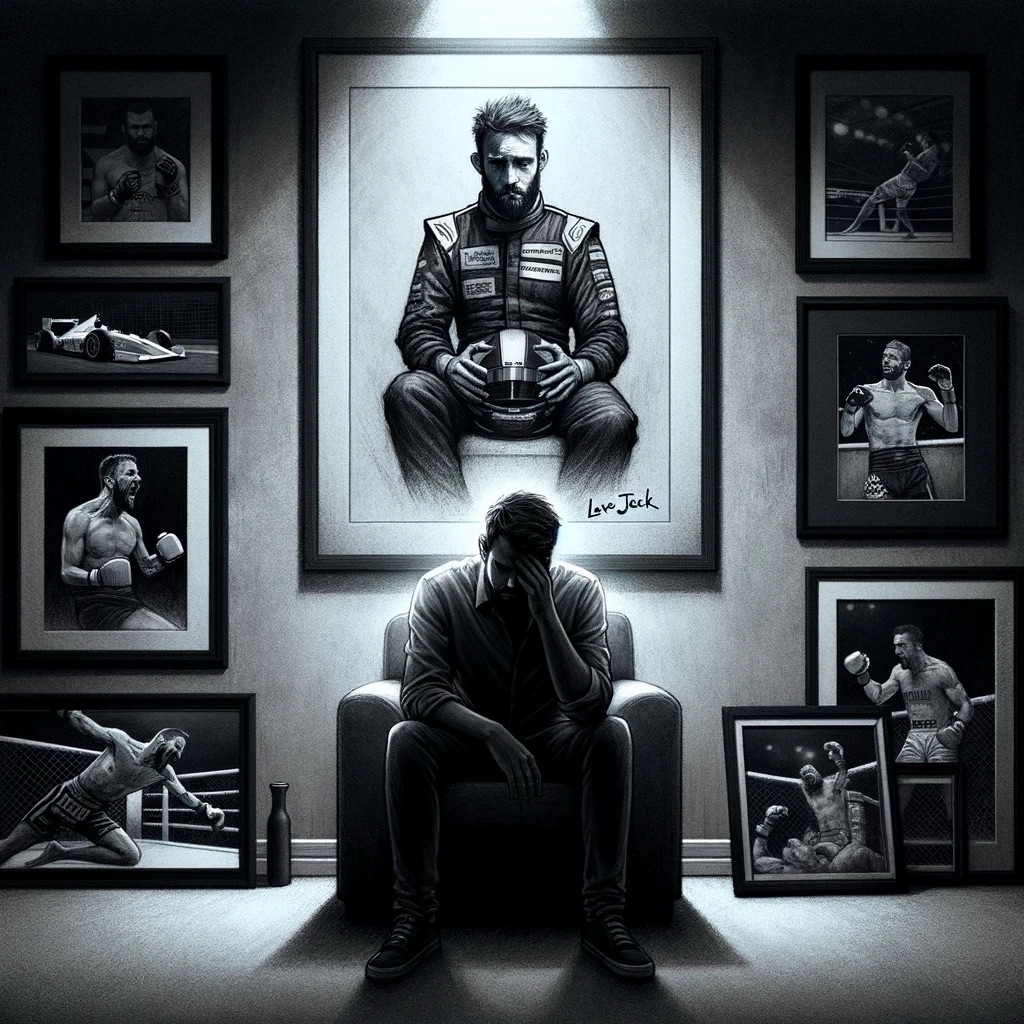
    A father sits in a dimly lit room, cradling his grief, his heart a museum of memories.
    Conundrum portraits hang on walls, opposite sides of the room.
    He sits all too sober, wrestling demons of vengeance and angels of virtue, in a dry and colorless world of absence and abstinence, wishing for whiskey, but those days are long gone. Today, an empty glass of sorrow is casting shadows he calls good company.
    Thinking of the son, gone too soon, a story that ended mid-sentence, left him bereft with a deafening silence, unable to utter the words, choked by the excruciating lump in his throat.
    He tries to fight back with all he can muster but nothing’s as painful as the smoldering ashes of acceptance he’s left to swallow. Once happy go lucky, now lucky to catch a glimpse of happy, he looks up at the sky, doesn’t see blue, just black clouds and broken hearts that he hopes will cover up the retaliatory bomb shot he’d like to take on the Cholo who took Jack’s life.
    There’s no romance in this kind of pain, no poetic justice waiting at the end of a barrel, just a half-broken father, a fighter with a heavyweight heart, each day looking dead-eyed into the sorrow glass memories—yes, they bring tear drops, some days an ocean of sadness, others, enough to set the universe on fire.
    Dad, being from the old school, tries to hold it in, fighting the ache in his chest. Thinking of Jack, how they used to fight, side by side, in garages and rings, where blood and sweat were nuances of beautiful frames on the canvas. Now the fights are quieter, lonelier, punchy memories that jab back sharper than any right hook. There’s an art in being knocked down for the count and getting back up, but this one leaves dad sideways, like the pieces of Jack’s work that still hang on the wall, only they leave dad eternally face down, Jack’s pencil sketch interpretation of McDonagh’s movie, Locke, still dad’s favorite as he too, now driving alone, utters the same final words, “Fuck Chicago,” apropos, as he wallows through his internal prison, which, on a good day he calls, “An ode to all art and war left behind.”
    Holding an Irish rock in his hand, looking into the hag stone hole he paints in tricolor, hoping to find the answers. His brush strokes are now uppercuts, heavy, angry, and desperate. There’s no victory in this fight, no heavenly intervention, just a man, his clenched fists, and his ghosts. He stares into the bottom of his empty glass of sorrow, the boy’s face always looking back. Every day he wakes is another bell rung, another round, face to face with fate, and a middle finger from the gods he refuses to embrace. Heaves the stone through the glass he watches it shatter all over the room, walking over broken shards it occurs to Jack’s old man, he knows he no longer believes in much, but he does believe in this: the fight goes on, even if all he’s fighting is himself.

  • Mediocrity (Ignore Everything I Wrote)

    Mediocrity

    Embrace the futile pursuit of some obscure designer lingerie called Agent Provocateur because, obviously, the key to reviving a relationship is to awaken the lifeless corpse that’s been hiding under the covers for far too long.

    Lavish yourself with Gucci, Louis Vuitton, and the overt indulgent, creepy pedophiles at Balenziaga because materialism cures all existential despair, right? Oh, and don’t forget that iPhone 15 that never leaves the clutches of your carpal tunnel-afflicted hands, a sheer masterpiece of exploitation, crafted by modern-day sorcerer children in a sauna they call an office somewhere in a COVID-infested Chinese cellar.
    Stick it nonchalantly into your coat pocket, ignoring empathy and instead celebrating the evolution of a digitally connected sixth finger that you might as well shove up your ass before the whole shit house goes nuclear.
    Of course, we mustn’t neglect the holy trinity of social media: TikTok, SNAPCHAT, and Instagram – the ultimate trifecta of meaningless validation. Spew the vile yet mundane nothingness of your existence, writing paragraph upon paragraph in excruciating detail because nothing says ‘I’m alive’ like sharing your breakfast choices, bowel movements, and Cinnabon recipes, even if it means ignoring the glaring truth that no one gives a fuck.
    And, while you’re scrolling through the virtual assembly line of wall to wall shit, stalk ex-flames, comparing their train wrecks to your dumpster fire while subconsciously hoping for any flicker of validation.
    Get a tattoo that reads “personal privacy is for losers” as you realize all of humanity is just an Excel sheet of cold data… then get on Snapchat in hopes of squashing that mountain of anxiety growing in your chest, only to score some cheap, counterfeit Xanax made by a slimy Sinaloa cartel terrorist who’s loaded it with enough Fentanyl to wipe out an entire sorority.
    And then, in an act of pure disassociation and impulse, embrace your inner stand-up comedian, by joking about sensitive topics you scream out-loud in overcrowded elevators, “not a single fucking life matters, so why not get the abortion, or don’t, have that tax write off and let the baby change its gender when she turns four”
    Hope you get canceled because nothing’s funnier than human suffering with no hope of redemption.
    Reinvent historical events, or better yet, pretend they never happened, especially if they don’t fit the lie of your twisted narrative.
    Embrace losing yourself in the maze of a 9-to-5 cubicle farm that slowly crushes the soul from those hipster sneakers you once bought for 12 dollars at a flea market. All while telling yourself, ‘see, I’m not shallow .’
    And pass this legacy of despair down to your children because suffering is a family heirloom, after all.
    Cherish your unfulfilled promises as they gather dust alongside the mantel of participation trophies and shattered dreams.
    Bask in the glow of your own repeated failures like a moth drawn to the same broken lightbulb.
    Observe the déjà vu of history because originality is overrated, and everything new is just something old and forgotten.
    Embrace that you’re merely, at best, below average, hide your tears with a smile, kiss your loved ones goodbye, one disappointment at a time.
    Fade away into obscurity, bit by bit, until you’re nothing but a distant memory to your own mother.
    Fall in love with this joke, this depressing carnival of life, and embrace every last ounce of mediocrity straight to the grave.

  • Unconscious and Entitled

    Unconscious and Entitled

    In a dimly lit room, with the flicker of a single, dying light bulb overhead and the hum of the city’s night leaking through the cracked window, there it sits—the essence of a world spoiled to its very core, marinated in its self-entitled glory. It’s an American tradition, not the kind bound by the pages of history books or celebrated with fireworks, but the kind you see in the glazed eyes of the too-many, wandering through their days like kings of a forgotten kingdom, unaware of the ground beneath them or the sky above.

    The streets are filled with the sounds of their discontent, a chorus so constant it blends into the backdrop of daily life. “The wifi’s too slow,” they cry, in cafes where the coffee beans have traveled further than their complaints ever will. “There’s nothing good on Netflix”, they moan, flipping through a thousand channels on their flat screens that glow like false moons in their too-big houses. They drive cars that could feed families for months, to jobs they say suck the soul from their bones, not pausing to think of those who sift through bones for a meal.

    This great American spoilage, it’s not just in the things they have but in the air they breathe, taken for granted like the last cigarette in a pack, smoked without thought or care for where the next might come from. It’s in the way they view the world, through lenses tinted with convenience, unable to see the beauty in struggle, or the strength it takes to simply survive in places where the ground is harder, the water scarcer, and the sky a luxury afforded only to the dreamers.

    They throw words like “hardship” and “struggle” into conversations like loose change, not knowing the weight of those coins in pockets other than their own. They speak of rights as if they were the only ones to have them, blind to the fact that for some, rights are not a given without a battle fought every day.

    And yet, amidst this spoiled landscape, there are those who see, truly see, the absurdity of it all. They’re the ones that nod to one another in passing, those who understand that to appreciate the light, you must also know the dark. But they are the whispers in a storm of shouts, the flickers of truth in a sea of contented ignorance.

    So here’s to the spoiled, the entitled, the blissfully unaware—may you one day find the beauty in a single blade of grass, the wealth in a shared meal, the fortune in a breath of air without having to experience some godawful tragedy in order to gain perspective.

    Until then, the world waits, not so patiently, for you to regain consciousness and see the value of looking passed your sixth finger, which is now a mobile device, a screen serving as a detour to personal hell. We’re anxious for you to wake up and see that while the American Dream may have always been a nightmare, there’s so much still out there, sprawled out like a roadmap of a million smiley faces, waiting to be titillated , waiting to be traveled and truly seen.