If you had the power to change one law, what would it be and why?
I’ve been sitting with this question longer than I expected to. Not because I lack answers — but because the more honest ones don’t arrive cleanly.
If I had the power to rewrite one law, I would hesitate — not out of humility, but out of suspicion. History suggests that anyone eager to rewrite the rules usually believes they are the exception to them.
I’ve learned to distrust simple answers, especially the ones that arrive wearing moral certainty like a uniform.
That’s the trap.
Every age produces its architects of certainty — people convinced they’ve finally identified the flaw in humanity that can be corrected with enough authority and a well-placed signature. They come armed with good intentions and leave behind unintended consequences.
So when someone asks me which law I would change, I find myself resisting the premise. Not because nothing needs fixing — plenty does — but because the desire to impose order often reveals more about our fear of chaos than our understanding of truth.
The problem isn’t that laws exist. The problem is that laws are blunt instruments trying to govern something that refuses to be blunt: human beings.
Maybe the real issue isn’t legislative at all.
Maybe it’s cultural.
We say we believe in free speech, but what we often mean is safe speech. Approved speech. Speech that arrives pre-sanitized so no one has to feel the friction of disagreement.
But truth rarely arrives politely.
Truth interrupts. It disturbs. It exposes contradictions — especially where power insists none exist.
Somewhere along the way, we stopped fearing censorship from above. And started practicing it on ourselves.
Quietly. Efficiently.
Until silence began to feel natural.
Consensus has never been a reliable compass for truth. Every meaningful shift in human history began as something offensive to the status quo — not because it was cruel, but because it refused to conform to the narrative everyone else had agreed to protect.
The most effective form of control isn’t imposed by force. It’s adopted willingly — when people learn to silence themselves before anyone else has to.
The hardest freedom isn’t speaking without limits. It’s choosing restraint when you could easily go further.
I’ve learned that life doesn’t exist in slogans. It lives in the gray spaces — in contradiction, in tension, in the uncomfortable distance between certainty and doubt.
Maybe that’s why I hesitate.
Not because I lack opinions — I have more than enough — but because every law begins as someone’s certainty, and certainty has a habit of mistaking control for wisdom.
We imagine the right rule will finally fix us. That somewhere there exists a perfectly worded sentence capable of correcting human chaos.
But chaos isn’t a flaw in the design.
It is the design.
We are contradiction walking upright — capable of cruelty and grace within the same breath.
And so I resist the urge to legislate discomfort away.
Because the real danger isn’t that people might hear something they dislike.
The real danger is that we stop risking honesty altogether.
So if I had the power to rewrite one law, I suspect the bravest thing I could do would be nothing at all.
Not out of apathy.
Out of respect.
Because maybe the most important law isn’t the one we write.
You will be told to keep it down. You will be called edgy, angry, reckless, dangerous, misinformed. You will be warned to think before you speak, but the only ones worrying about your volume will be those who fear your voice. Truth is treated as noise by those who live securely behind their own proof of lies. We’ve been told who to hate, we’ve been told who to trust, we’ve been told when to mourn, we’ve been told what to fear. And with each order, they’ve made the world quieter, emptier, and easier to control. A country where anger, grief, heartbreak, and dissent are classified as symptoms instead of signals. Turn it up until they know your name. Shatter the windows. Wake the neighbors. They tell us to be disarmed. Let’s make sure they can’t sleep.
If you could un-invent something, what would it be?
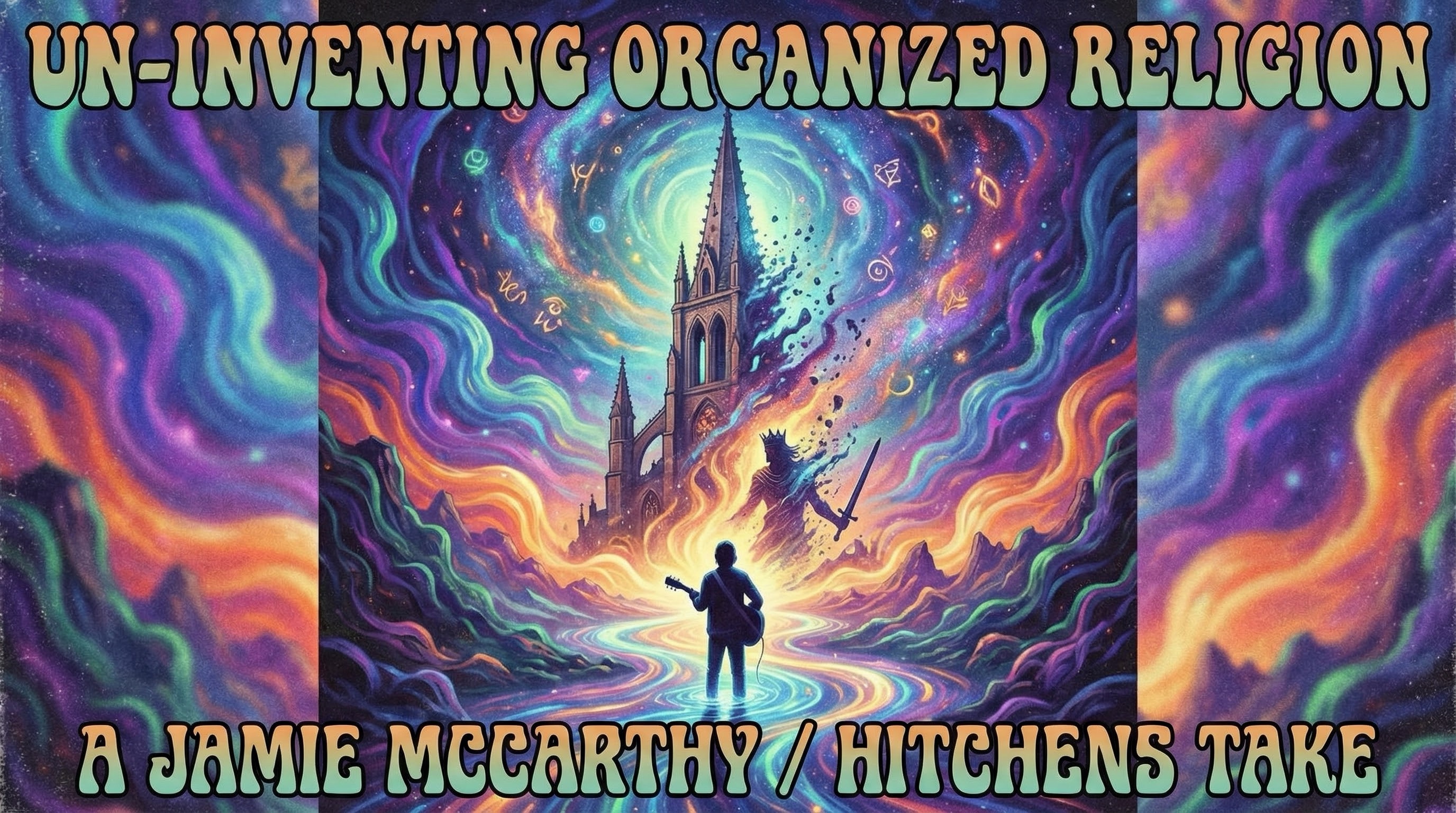
If I had to un-invent Organized Religion, let’s be clear: I wouldn’t be trying to kill God. I’d be firing the middle management.
I would dissolve the corporation of faith. Because that is what it has become: a global franchise that sells you water while you’re standing knee-deep in a river.
There is a profound difference between the spiritual impulse—that raw, undeniable feeling you get when you write a lyric that tells the truth, or when you sit in silence and actually face your own Jungian shadow—and the rigid structures that demand you outsource your conscience.
Hitchens would call it a “celestial dictatorship,” and he’d be right. It is the ultimate Orwellian surveillance state. It demands we surrender our modern intellect to the whims of bronze-age provincials. It insists we take our moral cues from illiterate merchant warlords who solved their disputes with the sword and claimed divine permission for their questionable domestic arrangements.
Why should the messy, beautiful search for meaning be held hostage by the egos of men who have been dust for a thousand years?
If we un-invented the organization, we wouldn’t be left with nothing. We would be left with us. We would be forced to build our own moral architecture, brick by brick, based on empathy and reason rather than fear. We would have to find the divine in the faces of the people we love—and the people we mourn—rather than looking for it in a gilded cage.
True spirituality requires bravery. It requires the guts to walk into the dark without a map. Organized religion is just selling you a flashlight with dead batteries and telling you it’s the sun.
the day after Ruby attempted suicide by banging his head on the walls of his jail cell.
Gather close, children of the static.
Tonight’s sermon is brought to you by the Un-United States Government,
that eternal pharmacy of the damned,
and by one Dr. Louis Jolyon West —
Jolly, for short.
A nickname that tells you everything and nothing, which is exactly how the good doctor liked his patients.
Now… I’m not here to tell you whether Charles Manson was a monster or a kid who wrote bad folk songs until the nation decided to turn him into an exorcism ritual for everything it feared about itself.
That’s not my job.
My job is to peel the wallpaper off history and show you the termite tunnels beneath.
Follow me.
Picture Jolly West in his tweed jacket —
a man who looked like he’d apologize
before cutting your consciousness into strips.
A man who weaponized curiosity
and called it compassion.
He’d inject you with questions
before the syringe even touched your skin.
They say he treated broken minds.
I say he manufactured them wholesale.
He was the kind of doctor
who could hand you a glass of water
and three days later
you’d be confessing crimes you didn’t commit
in languages you didn’t speak.
Some say Manson spent time in his orbit.
Some say coincidence is just God hiding the blueprints.
Some say neither Jolly nor Charlie ever met.
And some—
some of us just ask the one question
you’re not supposed to ask in America:
Who benefits when a nation goes mad?
Look around.
Chaos is an industry.
Fear is a commodity.
And the human mind—
well, that’s just clay for the sculptors
who sit in the windowless rooms
three floors below the truth.
But tonight…
tonight we honor Charles.
Not the killer,
but the songwriter he might have been
before someone decided
his chords needed more dissonance.
I imagine him strumming in some halfway house,
dreaming of fame
while a doctor in a lab coat
scribbled notes about “suggestibility thresholds”
and “malleability of identity.”
It doesn’t matter what’s true.
It matters what’s plausible.
And America…
America has a way of making the plausible feel like prophecy.
Some of us were dumb enough to think we were chosen. Destined for greatness. I was one of those fools.
Then life swung for the skull—my father gone when I was just twenty-four, my son gone at nineteen. That’s the punchline. And I’m still here, scribbling like a clown juggling knives at his own funeral.
Every line I write turns to rope. And rope’s a funny bastard—you can climb it, you can hang from it. Lifeline and noose, same damn thing.
And here’s where I laugh at myself: I can’t stand writers who always find a way to make it about them. But don’t mistake this for that—this isn’t me making it about me. This is me making it about you, making it about me. That’s the kind of pretzel you twist into when you’ve got nothing left but your own shadow to wrestle with.
Greatness? That’s the carrot they dangle so you’ll chase yourself into the grave. The truth is simpler: I’m under the gallows, grinning through broken teeth, laughing at my own execution, and the only reason I keep writing is because hanging myself with my own words is the one thing I’ve ever done well.