I’m always five minutes late. Doesn’t matter if it’s therapy, a meeting, or a funeral—hell, I know for a fact i’ll be late to my own, if I even show up at all.
I’ve been seeing this shrink for a while now. Good guy. Listens well, scribbles occasionally, throws a “hmm” out like he’s adding salt to a shitty dish his wife whipped up. So, one day, after the usual “you’re late again” look, he finally asks me, “James, why are you always five minutes late? No matter what time we set, it’s always the same.”
I shrug, staring at his overly polished desk, and say, “Well, Doc, best as I can figure, my five minutes and your five minutes just aren’t the same.”
He raises an eyebrow like I’m onto something. Like I’ve finally cracked the code to the universe of perpetual tardiness. So, I keep going.
“See, your five minutes, it’s precise. Probably feels like 300 seconds ticking away, one, two, three. But mine? Mine could be five seconds, or five hours. I don’t feel the difference.”
I could tell he wanted to laugh but was trying hard to remain the professional. He adjusts his glasses, the kind of move therapists do when they’re buying time to decide if they should diagnose you or just let it slide.
“Maybe it’s because you taught me to live in the moment, Doc. You ever think about that? Maybe I’m just so focused on the now that time… bends. It warps around me like some kind of slow-motion bullet in a movie. Except, instead of dodging it, I’m just late.”
my old man was tough but I wouldn’t call him a bastard, rough hands, stentorian voice, but it was those eyes, they were odd in a beautiful yet chilling way , the way he’d stare right through me, like he already knew the end. he checked out early, left me holding the bag— a kid too young to know the game was rigged. I got older, meaner, learned to drink it down, fill the empty spaces with smoke and bad decisions, but nothing ever took root, just ashes in a cheap ashtray. then my boy, Jack all bright-eyed, all promise and fire, went cold at nineteen. like he was never even here. one day laughing, the next day gone, As if the most beautiful ghost ever decided to punch my gut and keep walking. so now it’s just me, an old man stuck between some past that’s long dead and a future that’s already given up. they talk about the Father, the Son, and some Holy Ghost— but what do they know about ghosts? all I got are dead men’s whispers and shadows that follow me from room to room. maybe I’m the ghost now, some sober, leftover thing, wandering between bad memories and worse nights, waiting for that final bell to ring me out. but until then, I’ll keep dreaming of drinking the cheap whiskey that almost drown me, chewing the lousy cigarettes I cannot light and telling those ghosts to fuck off— because it’s all just a bad joke , a hit— and I am the punchline.
The dream hits like a cheap shot after last call, every night, same damn thing. There he is, the poor bastard, standing on the edge of nothing, staring at the horizon where the sea meets the sky. It’s calm, too calm, like the silence before a bar fight. And then, out of nowhere, it comes—a tidal wave a mile high, a wall of watery doom.
This isn’t some Hollywood disaster flick. No, this wave is real, raw, unfiltered. It rises with the fury of every unpaid bill, every broken promise, every lonely night spent in the bottom of a bottle. It’s the weight of existence, the crushing force of life’s relentless bullshit.
The man, he doesn’t run. There’s no point. He stands there, rooted to the spot, like a drunk pinned by a cop’s flashlight. He knows what’s coming, knows he can’t escape it. It’s not about courage; it’s about acceptance. He’s staring down the barrel of inevitability, eyes wide open, heart pounding like a bum’s fist on a midnight diner counter.
The wave looms, casting a shadow that swallows the sun. It roars, the sound of a million lost dreams and forgotten loves. It’s beautiful, in a way, this monstrous, all-consuming force. There’s a terrible beauty in surrender, in the recognition that fighting is futile. The wave crashes, and for a moment, everything is chaos, a swirling, suffocating mess of saltwater and despair.
But then, there’s a strange peace. The man is engulfed, yes, but in that drowning, there’s release. No more running, no more struggling. Just the cold embrace of the inevitable. It’s over, and in the end, maybe that’s all anyone can hope for—a moment of clarity in the madness, a brief respite in the endless tide of life’s absurdity.
Life’s a wave, kids. You can’t outrun it. You just stand there, take the hit, and hope to hell you find some meaning in the drowning.
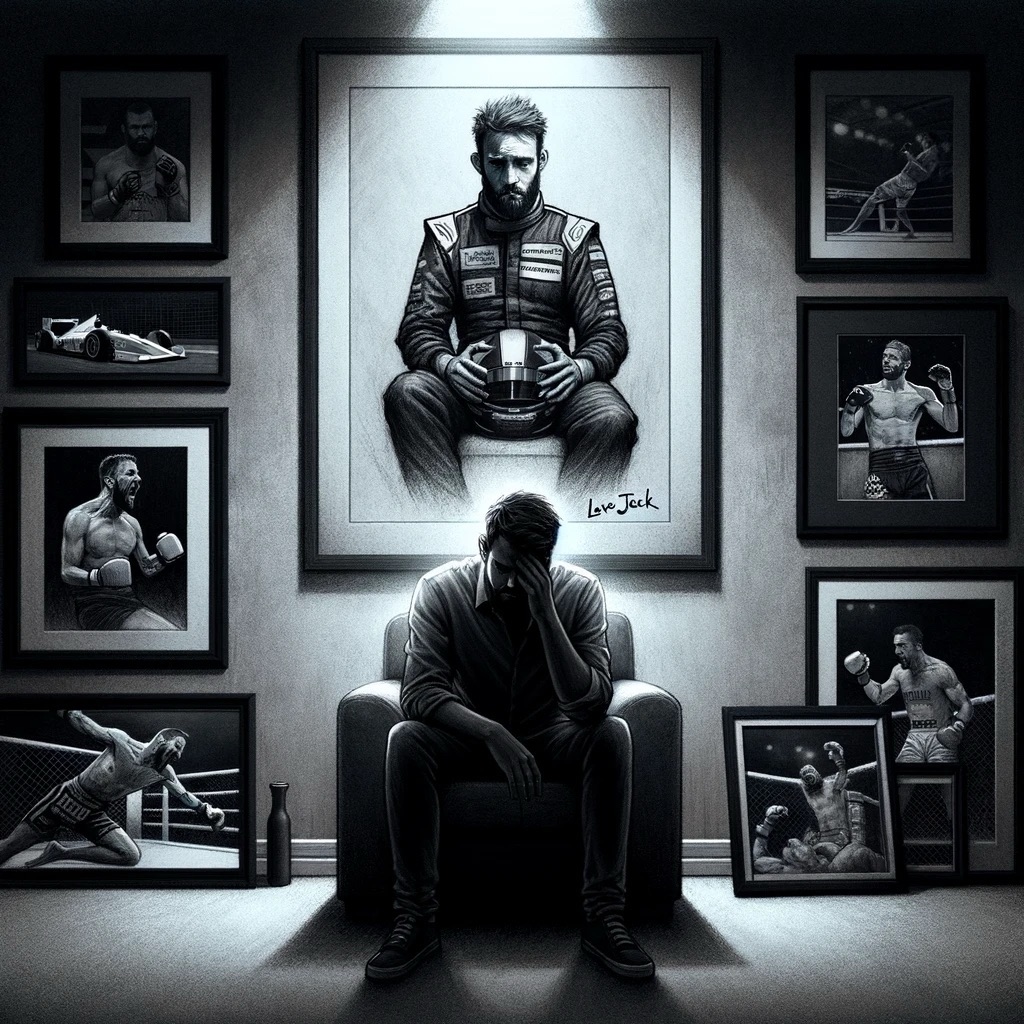
A father sits in a dimly lit room, cradling his grief, his heart a museum of memories. Conundrum portraits hang on walls, opposite sides of the room. He sits all too sober, wrestling demons of vengeance and angels of virtue, in a dry and colorless world of absence and abstinence, wishing for whiskey, but those days are long gone. Today, an empty glass of sorrow is casting shadows he calls good company. Thinking of the son, gone too soon, a story that ended mid-sentence, left him bereft with a deafening silence, unable to utter the words, choked by the excruciating lump in his throat. He tries to fight back with all he can muster but nothing’s as painful as the smoldering ashes of acceptance he’s left to swallow. Once happy go lucky, now lucky to catch a glimpse of happy, he looks up at the sky, doesn’t see blue, just black clouds and broken hearts that he hopes will cover up the retaliatory bomb shot he’d like to take on the Cholo who took Jack’s life. There’s no romance in this kind of pain, no poetic justice waiting at the end of a barrel, just a half-broken father, a fighter with a heavyweight heart, each day looking dead-eyed into the sorrow glass memories—yes, they bring tear drops, some days an ocean of sadness, others, enough to set the universe on fire. Dad, being from the old school, tries to hold it in, fighting the ache in his chest. Thinking of Jack, how they used to fight, side by side, in garages and rings, where blood and sweat were nuances of beautiful frames on the canvas. Now the fights are quieter, lonelier, punchy memories that jab back sharper than any right hook. There’s an art in being knocked down for the count and getting back up, but this one leaves dad sideways, like the pieces of Jack’s work that still hang on the wall, only they leave dad eternally face down, Jack’s pencil sketch interpretation of McDonagh’s movie, Locke, still dad’s favorite as he too, now driving alone, utters the same final words, “Fuck Chicago,” apropos, as he wallows through his internal prison, which, on a good day he calls, “An ode to all art and war left behind.” Holding an Irish rock in his hand, looking into the hag stone hole he paints in tricolor, hoping to find the answers. His brush strokes are now uppercuts, heavy, angry, and desperate. There’s no victory in this fight, no heavenly intervention, just a man, his clenched fists, and his ghosts. He stares into the bottom of his empty glass of sorrow, the boy’s face always looking back. Every day he wakes is another bell rung, another round, face to face with fate, and a middle finger from the gods he refuses to embrace. Heaves the stone through the glass he watches it shatter all over the room, walking over broken shards it occurs to Jack’s old man, he knows he no longer believes in much, but he does believe in this: the fight goes on, even if all he’s fighting is himself.